
AI Business Process Automation: What’s Actually Working in 2026
AI business process automation is past the hype phase.
The numbers tell a clear story: 73% of businesses now use some form of AI automation in their operations. Enterprise BPA delivers ROI ranging from 30% to over 200%, with payback periods typically between 3 and 18 months. Across industries, AI process automation is linked to 20-30% time savings per employee and 30-50% faster cycle times on execution-heavy workflows.
But the same data shows why results vary so dramatically. 31% of organizations report no change in costs despite investing in AI and automation — most commonly due to poor process selection, change management gaps, and integration complexity with legacy systems.
The technology works. The implementation is where most organizations succeed or fail.
What AI Business Process Automation Actually Means
Business process automation with AI is not the same as traditional automation. The distinction matters because it determines what’s automatable.
Traditional automation executes fixed rules. If X happens, do Y. It works on structured, predictable processes where every input type is known and every output is defined.
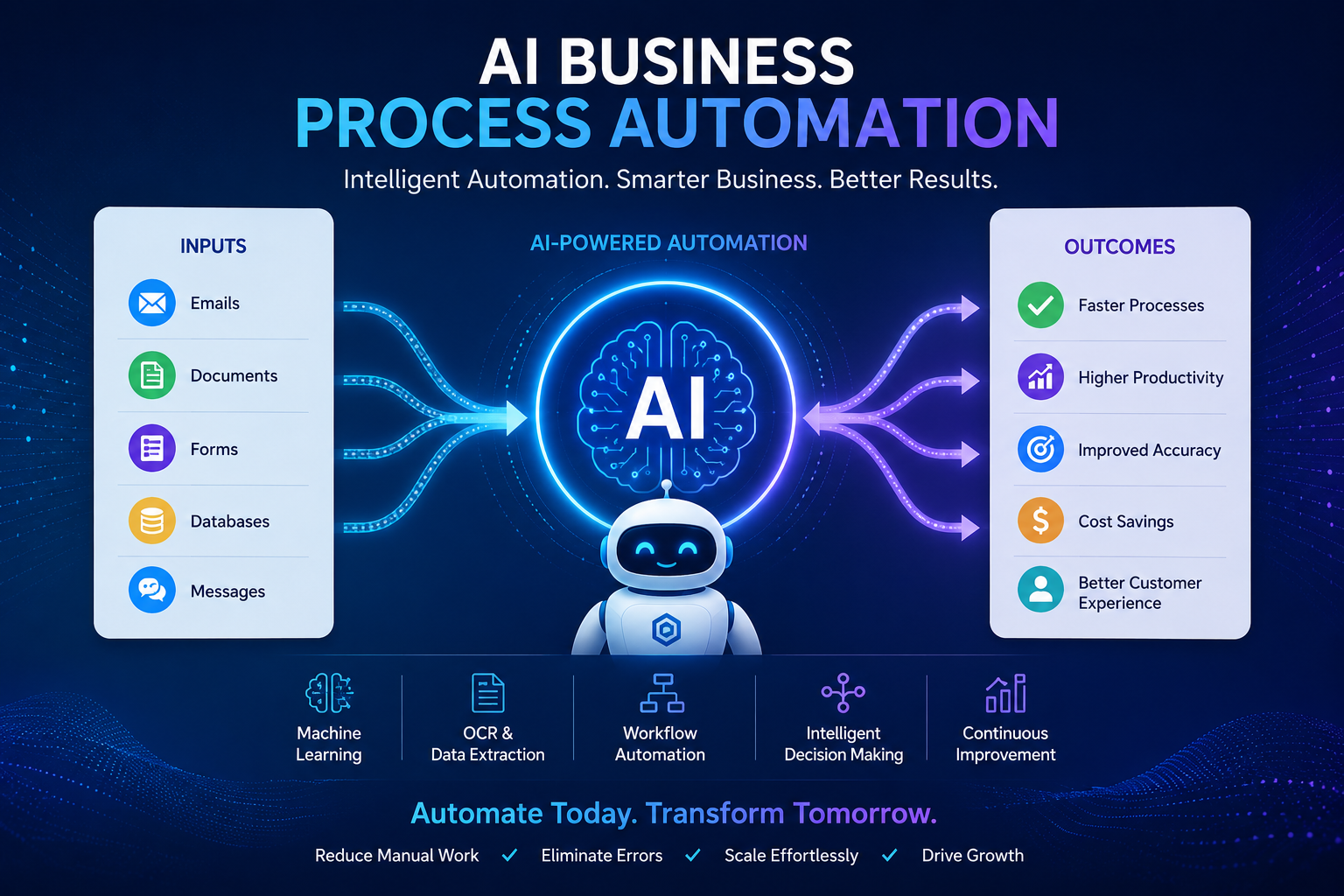
AI-powered business process automation adds a judgment layer. The system can read unstructured inputs, make routing decisions based on content rather than rigid rules, handle exceptions, and improve over time as it encounters new cases. AI for business process automation means processes that previously required human reading and judgment can now have an AI step — with humans reviewing only the cases where errors would be consequential.
The practical gap this closes: coordination work. McKinsey’s research on AI in operations consistently points to coordination overhead, manual follow-ups, and fragmented workflows as the primary bottlenecks AI successfully addresses. Most operational delays aren’t caused by poor decisions — they’re caused by execution friction around those decisions.
Where AI in Business Process Automation Delivers the Most Value
Finance and Procurement
Finance and procurement processes consistently generate the highest BPA ROI. The reasons are structural: high transaction volumes, clear error-reduction potential, and well-defined success metrics.
Invoice processing. A logistics company processing 10,000+ invoices monthly reduced processing time from 5 days to 4 hours with 99.2% accuracy using AI document processing. The savings exceeded $100,000 annually in labor costs. AI reads the invoice, extracts vendor, amount, date, and line items, matches against purchase orders, flags discrepancies, and creates accounting entries — with human review only for exceptions.
Expense management. AI classifies expenses, checks policy compliance, identifies anomalies, and routes for approval — without a human touching routine, policy-compliant expenses.
Procurement workflows. Purchase request routing, vendor validation, budget checking, and approval management — all automatable with AI agents that understand the content of requests, not just the rules about them.
Customer Service
Customer service has the highest AI adoption rate of any department — 56% — and for clear reasons. AI handles 30% of customer interactions today, projected to reach 50% by 2027.
AI agents for business process automation in customer service handle tier-one queries automatically: order status, password resets, basic troubleshooting, billing questions. They classify incoming requests, extract relevant context, draft responses, and route complex cases to humans with context already prepared.
The ROI driver: scale. An AI customer service system handles volume that would require proportional headcount growth, without the per-interaction cost.
HR and Recruiting
Resume screening and candidate routing. AI reads applications, evaluates against defined criteria, and routes qualified candidates — reducing the manual review work that consumes significant recruiter time.
Onboarding workflows. New hire document collection, system provisioning, training assignment, and compliance acknowledgment — each step triggered automatically, with status tracked and escalations fired when steps aren’t completed on time.
Employee inquiry routing. Common HR questions — benefits, leave policies, payroll — handled by AI with access to the company knowledge base.
Operations and Compliance
Document classification and routing. Contracts, applications, reports, certifications — AI reads documents, extracts key fields, classifies the document type, and routes to the appropriate workflow.
Compliance monitoring. AI monitors transactions and communications for compliance signals, flags exceptions, and creates audit trails — continuously, at a scale impossible for human review teams.
Quality control. Inspection data, customer feedback, and operational metrics analyzed in real time, with anomalies flagged before they become incidents.
Agentic AI for Business Process Automation: The 2026 Shift
The most significant development in business process automation with AI in 2026 is the move from task automation to agentic AI.
82% of organizations plan to introduce AI agents within the next one to three years to handle tasks such as email creation, coding, and business analytics. The shift from “automating tasks” to “agentic AI for business process automation” is the shift from executing defined steps to pursuing goals autonomously.
An AI agent reviewing an incoming request doesn’t just route it. It classifies urgency, identifies the right approver, checks for missing information, sends reminders, updates workflow status, and escalates if delayed — without human intervention at each step.
This matters because businesses want automation that does more than move tasks from one person to another. They need workflows that can reduce manual follow-ups, improve decision speed, detect issues earlier, and keep processes moving without constant human intervention.
The practical implication: the AI automation layer that’s becoming standard in enterprise operations is increasingly agentic — not just rule-based or single-step.
The 31% Problem: Why AI Business Process Automation Fails
The statistic that deserves more attention: 31% of organizations report no change in costs despite investing in AI and automation.
The failure modes cluster around the same issues:
Wrong process selection. Not every business process is a good automation candidate. AI-powered business process automation works best on high-frequency, structured, data-intensive processes where the judgment required is learnable from examples. It works poorly on low-frequency, highly variable processes that require genuine situational judgment.
Change management gaps. Automation that replaces a human workflow requires the humans whose workflow changed to actually change how they work. Organizations that deploy automation without addressing adoption — training, communication, workflow redesign — get tools nobody uses.
Integration complexity. Most business processes span multiple systems. Automation that doesn’t connect to the systems where data lives and where outputs need to go produces islands of efficiency surrounded by manual handoffs.
No measurement baseline. If you don’t measure the process before automating, you can’t measure the improvement after. Organizations that skip baseline measurement can’t demonstrate ROI, which makes continued investment difficult to justify.
How to Implement AI Business Process Automation That Delivers ROI
The implementation approach that consistently produces results:
Start with process selection, not tool selection. Identify the high-frequency, structured processes where you have good data, clear success criteria, and enough volume that automation ROI is obvious. These are your first candidates.
Map the real process before automating it. The process as documented and the process as actually practiced are often different. Automate the real process, not the documented one. Discover the difference in a discovery phase, not during deployment.
Build the human review layer deliberately. AI business process automation that runs without human oversight on high-consequence outputs is a liability. Design the oversight model before deployment — which outputs require human review, what triggers escalation, who reviews what.
Measure before and after. Define the metrics that matter — processing time, error rate, cost per transaction, cycle time — measure them before automation, measure them after. This is what turns an automation deployment into a demonstrable ROI story.
Expand from the first success. The first successfully automated process validates your approach and builds organizational confidence. Use it as the template for the next one.
According to McKinsey, companies that start using AI sooner often see their operations run about six months more smoothly than those that hold back. The compounding effect of early, consistent automation investment is significant.
The Business Process Automation Statistics That Matter
A few numbers worth having for the ROI conversation:
- 73% of businesses use some form of AI automation in operations
- Enterprise BPA ROI: 30-200%, payback 3-18 months
- 20-30% time savings per employee on automated workflows
- 30-50% faster cycle times on execution-heavy processes
- 85% error rate reduction in data entry and processing
- Customer satisfaction improvements of 35% when AI-powered support is deployed
- 90% of large enterprises have hyperautomation as a strategic priority
The full picture from McKinsey’s research on AI in operations is worth reading for any organization making significant automation investment decisions.
AI business process automation in 2026 is a proven category with clear ROI in specific applications — and a category where poor implementation still produces the 31% of organizations that see no benefit from significant investment.
The difference is process selection, implementation rigor, human oversight design, and measurement. The technology delivers. The implementation is where the work actually is.
The business automation guide covers the strategic framework. The specific AI layer on top is what’s changed most in the last two years — and what makes the ROI numbers above achievable for organizations that implement it correctly.
Related Reading on FutureLume
- AI Automation Examples for Business: What’s Actually Working in 2026
- Small Business Automation in 2026: 58% Are Already In, Here’s What They’re Actually Automating
- What Is Business Automation? And Why Most Companies Get It Wrong
- AI Marketing Automation in 2026: What’s Actually Working (And What’s Still Hype)