


Every company says they’re automating.
Very few are doing it in a way that actually sticks.
I’ve watched teams spend months building automation workflows that broke within weeks. Or automating processes that were already broken — just faster now. Or buying tools that looked great in a demo and created three new problems while solving one.
The companies doing it well are quieter about it. They pick specific things. Build reliably. And the people who were doing those tasks manually end up doing something that actually requires them.
That gap is what this is about.
So What Is Business Automation, Actually
Using technology to handle tasks that follow predictable rules — without a human doing them manually each time.
Simple enough. But the word “predictable” is carrying a lot of weight there.
Automation works when the rules are clear. When the same input reliably produces the same correct output. When failures are known and handleable. When you don’t need someone reviewing every result to catch mistakes.
It breaks down when the task needs real judgment. When context shifts in ways rules can’t anticipate. When an automated error costs more than just doing it manually.
Most companies get into trouble automating things that look rule-based but aren’t. Or not thinking about what happens when something fails.
What It Actually Covers
The category is broader than people assume.
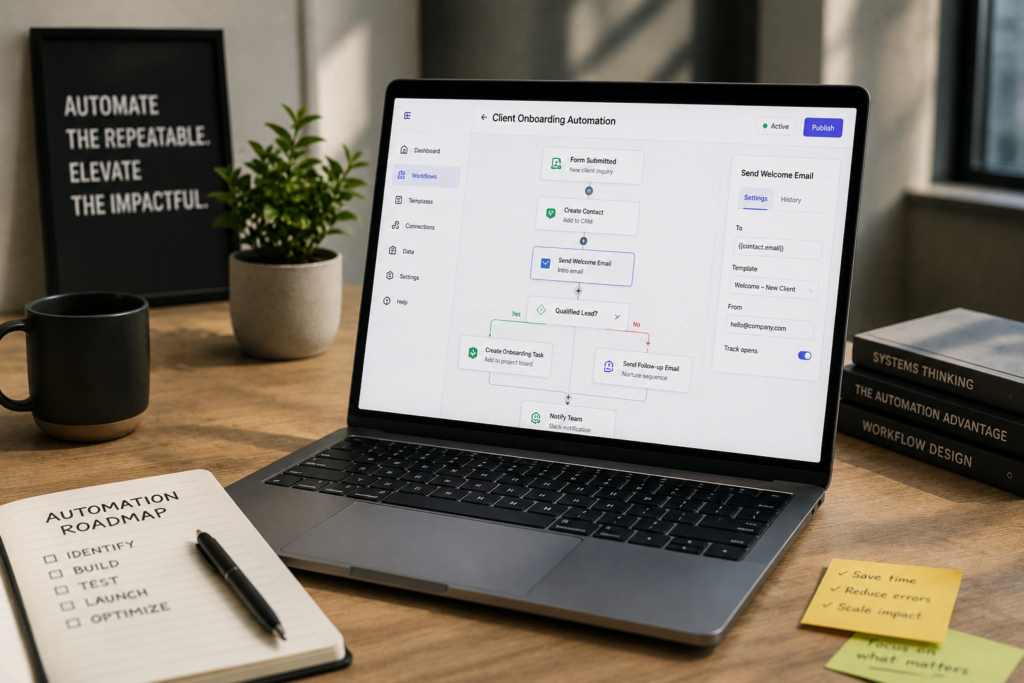
Workflow automation — moving information between systems without manual data entry. Form submission triggers CRM update triggers email triggers task. No human needed in that chain.
Process automation — standardizing how multi-step work gets done. Approvals, onboarding, invoice processing, report generation. Same process every time means it can run without someone managing it.
Document automation — generating, routing, processing documents without manual handling. Contracts, proposals, compliance reports.
Communication automation — triggered emails, SMS, internal notifications. Based on behavior, timing, or system events.
Data automation — moving and syncing data between systems. The plumbing that keeps things consistent without someone manually exporting spreadsheets at 9am every Monday.
The best workflow automation tools in 2026 cover most of these. The question isn’t the tool. It’s which process to start with.
Why Most of These Projects Fail
Same pattern every time.
Company decides to automate. Picks a tool. Tries to automate everything at once. Complexity grows faster than anyone can manage. Automations break in unexpected ways. Maintaining them becomes someone’s part-time job. Eventually someone turns them off and goes back to doing it by hand.
The specific mistakes I keep seeing:
Automating a broken process. Automation makes things faster, not better. If the process has redundant steps or unclear ownership, automation just amplifies the mess. Fix the process first.
Starting too big. The first automation should be small, high-frequency, low-stakes. Something that runs twenty times a day and nobody cares if the first version isn’t perfect. Start there. Then expand.
No error handling. What happens when it fails? “We’ll figure it out” is not a plan. Every automation needs a failure path that alerts someone before it cascades.
No owner. Automations without owners become technical debt. Someone needs to watch them, update them when something changes upstream, and be accountable when they break.
What’s Actually Worth Automating First
Not everything. That’s the answer nobody wants.
Best candidates: high-frequency tasks — happening dozens or hundreds of times a week. Rule-based — same input, same correct output. Currently done by people who shouldn’t be doing them. Low enough stakes that an early failure doesn’t cause a serious problem.
Data entry between systems. Triggered follow-ups. Report generation. Document routing. Lead assignment.
Not glamorous. Also where the hours actually go.
The fastest-growing AI companies in 2026 are embedding automation into specific vertical workflows — legal, logistics, finance — because the ROI in high-frequency rule-based domains is obvious once you do the math.
The Technologies Worth Knowing
| Technology | What It Does | Best For |
| RPA | Mimics human actions in existing interfaces | Legacy systems without APIs |
| Workflow platforms | Connects apps and triggers actions | Cross-system process automation |
| AI automation | Handles unstructured inputs | Document processing, classification |
| iPaaS | Syncs data between systems in real time | Data consistency across tools |
| BPA | Automates end-to-end business processes | Complex multi-step workflows |
The shift right now: AI is moving automation from strictly rule-based work into tasks that used to need human judgment. Document understanding, classification, extraction. Things that required someone to read and interpret can now be handled reliably by AI systems.
It connects to something bigger — how innovation changes what work humans need to do at all. Automation isn’t just efficiency. It’s structural.
The ROI Calculation Most People Skip
Before automating anything — run the honest math.
How many times does this happen per week? How long does it take? What’s the fully-loaded cost of the person doing it? How long will the automation take to build and maintain? What’s the likely error rate and what does each error cost?
Most automations that clear this are obvious. Most that fail it were automated because automation sounds good — not because the numbers work.
Treat it like any other investment. Clear ROI upfront. Measurement after. Accountability for whether the return actually showed up.
Done well, business automation is one of the highest-leverage things a company can do. Hours recovered compound. Consistency improves. People freed from mechanical work do better work elsewhere.
Done poorly — broken workflows, no ownership, fragile systems nobody wants to touch.
The difference is almost always the approach, not the tool. Start small. Fix the process first. Build error handling in from day one. Give it an owner.
The technology is the easy part.