
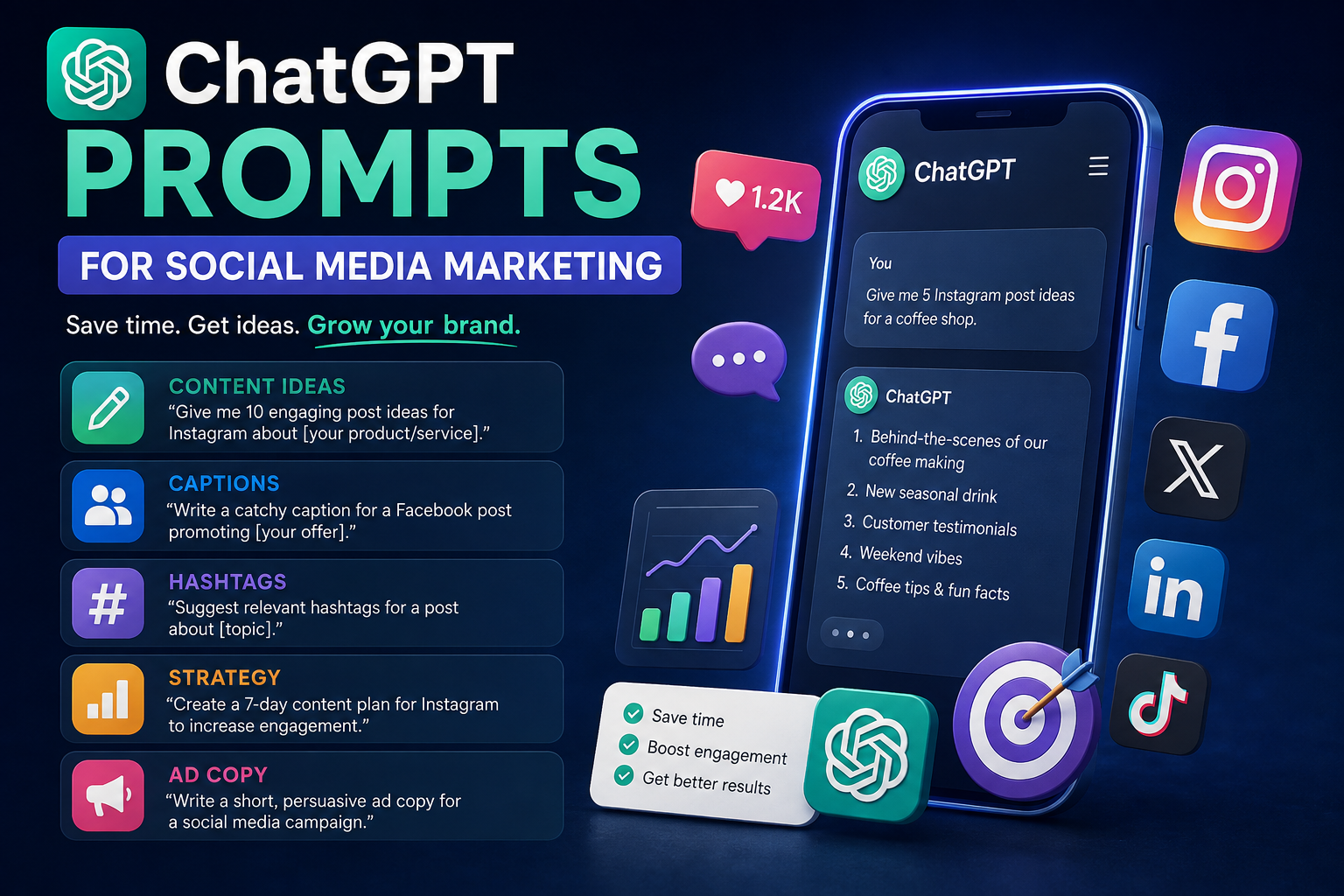
ChatGPT Prompts for Social Media Marketing: What Actually Works
Most ChatGPT prompts for marketing give you generic templates that produce generic output.
“Write a LinkedIn post about [topic].” The result sounds like every other AI-generated LinkedIn post — competent, inoffensive, immediately forgettable.
The prompts that actually produce useful social media content are specific, opinionated, and tell ChatGPT exactly what to avoid as much as what to include. Here’s what’s working in 2026.
Futurelume — where AI meets practical work
The Principle Before the Prompts: Why Most Marketing Prompts for ChatGPT Fail
Generic prompts produce generic content because ChatGPT optimizes for what sounds correct rather than what sounds like you.
To get content that actually fits your voice and your audience, your prompts need to include:
- Your actual voice — not “professional tone” but specific descriptors: direct, opinionated, uses short sentences, no corporate jargon
- What to avoid — often more useful than what to include
- The specific audience — not “small business owners” but “solo marketing consultants billing $5-10k/month who hate automating”
- A concrete goal — not “engagement” but “get people to comment with their own experience”
With those four elements, the output gets dramatically more specific and useful.
LinkedIn Prompts That Work
For a thought leadership post
Write a LinkedIn post in a direct, opinionated voice — short paragraphs, no buzzwords, no "I'm excited to share."

Topic: [your topic]
My actual take: [your genuine opinion on this, even if contrarian]
Target reader: [specific job title or situation]
Goal: Get people who disagree to respond in the comments

Avoid: "In today's fast-paced world," "game-changer," "leverage," "synergy," rhetorical questions that answer themselves.

End with a specific question that invites disagreement, not validation.

Max 200 words.
For a case study or result post
Write a LinkedIn post sharing a specific result without bragging.

The result: [what happened, with numbers if possible]
What made it work: [the specific thing that was different]
What most people get wrong: [the common mistake this avoided]
Target reader: [who this is relevant to]

Voice: First person, direct, no fake modesty and no self-congratulation. Like you're telling a colleague at lunch.

Max 150 words. No hashtags.
For a contrarian take
Write a LinkedIn post that pushes back on a common belief in [industry/topic].

The belief most people hold: [state it]
Why I think it's wrong: [your actual reason]
What's actually true instead: [your position]

Voice: Confident, not aggressive. Makes a specific claim rather than a vague "it depends."

The post should feel like an opinion piece, not a listicle. Max 180 words.
Twitter/X Prompts That Work
For a single tweet with a strong hook
Write a tweet that makes [target audience] stop scrolling.

The insight: [one specific, counterintuitive thing you know]
Voice: Blunt. No hedging. No "some people think." State it as fact.

Format: One sentence hook. Two or three sentences of context. One line payoff.

Do not use: emojis, hashtags, "thread incoming," or exclamation points.
For a tweet thread
Write a Twitter thread on [topic].

My actual position: [your take, not the conventional wisdom]
Audience: [specific description]
Goal: Someone shares this because it said something they've thought but never seen articulated

Structure:
- Tweet 1: Hook that makes a specific claim
- Tweets 2-6: Evidence or examples, one per tweet, no fluff
- Tweet 7: The practical takeaway
- Tweet 8: Call to action that isn't "follow me for more"

Voice: Each tweet should be able to stand alone. Short sentences. No corporate language.
Instagram Prompts That Work
For a caption that drives saves
Write an Instagram caption for [type of content/image].

Topic: [what you're sharing]
Why someone would save this: [the specific value — template, framework, reminder, reference]
Voice: Conversational, like a DM to a friend who asked for advice

Structure:
- First line: hook that doesn't start with "I" or "We"
- Body: the actual useful content
- Last line: tell them to save it and why

Hashtags: 3-5 specific ones, no broad ones like #marketing or #business
Max 150 words in the caption body.
For a carousel post caption
Write a caption for an Instagram carousel post about [topic].

The carousel covers: [what's in each slide, briefly]
Who this is for: [specific audience]
What they get from it: [the specific outcome or knowledge]

Caption structure:
- First line hooks without revealing everything (create curiosity for the swipe)
- 2-3 lines of context
- "Swipe to [specific benefit]"
- Save prompt
- 3 hashtags

Voice: Direct. Tells people exactly what to do and why. No hype.
Facebook Prompts That Work
For a community-building post
Write a Facebook post for [type of audience/group].

Goal: Get people to share their own experience in the comments
Topic: [what you're discussing]
The question you actually want answered: [the specific thing you're curious about]

Voice: Warm but not saccharine. Specific, not generic.

Format: 2-3 sentences of setup, then one direct question. No lists. No emojis unless they're genuinely useful.
Max 100 words.
The Prompt Structure That Works Across All Platforms
Regardless of platform, the prompts that produce the most useful output have this structure:
Platform: [LinkedIn/Twitter/Instagram/Facebook]
Content goal: [specific outcome, not vague "engagement"]
My position/take: [your actual opinion, even if unformed]
Target audience: [specific, not general]
Voice: [2-3 specific descriptors + 2-3 things to avoid]
Format constraints: [word count, structure, what not to include]
The “things to avoid” section is often the most important. ChatGPT defaults to certain patterns — rhetorical questions, vague calls to action, corporate language, hedging everything — that make social content sound AI-generated. Explicitly excluding these patterns produces dramatically better output.
How to Use These Prompts as a Starting Point
The prompts above are templates. The output they produce is a starting point, not a final draft.
The 20 minutes you save not writing from scratch should go into editing the output to sound more like you — tightening the language, making the voice more specific, adding the detail that only someone who was there would know.
The best AI tools for business includes tools that go further than basic prompting — Jasper, Copy.ai, and others that specialize in social media content at volume. But for most people producing social content regularly, ChatGPT with a good prompt structure outperforms the specialized tools at a fraction of the cost.
The skill isn’t prompt engineering. It’s knowing what you want to say clearly enough to tell the AI what to produce.
The best ChatGPT prompts for marketing — whether for social media, email, ad copy, or content — share the same structure: specific voice, specific audience, specific goal, and explicit instructions about what to avoid. The platform changes. The principle doesn’t.
If you’re looking for ChatGPT prompts for digital marketing beyond social media — email sequences, ad copy, landing pages, SEO briefs — the same framework applies. The more specific the context you give, the more specific and useful the output.