Top VPN Services in 2026: What’s Actually Worth Paying For
The VPN market is crowded with nearly identical claims.
Military-grade encryption. Strict no-log policies. Blazing-fast speeds. Every provider says the same things. But first — what does VPN mean? VPN stands for Virtual Private Network: an encrypted tunnel between your device and a server that masks your IP address and protects your traffic from being read by your ISP, hackers on public networks, or anyone else monitoring the connection.
The differences that actually matter — streaming reliability, privacy credentials, price after the introductory period, mobile VPN performance, browser extensions — take more digging to find.
Here’s the honest breakdown of the top VPN services in 2026, based on what independent testing actually shows.
Futurelume — covering technology practically
The Comparison Table
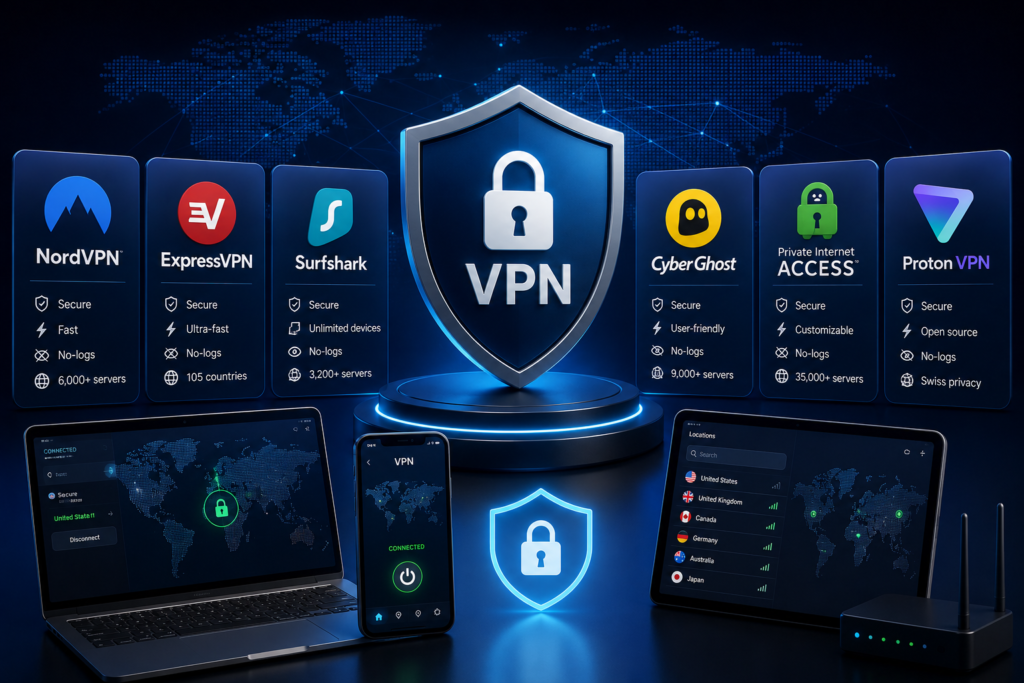
| VPN | Best For | 2-Year Price | Money-Back | No-Log Audit |
|---|---|---|---|---|
| NordVPN | Most people, streaming | $3.39/mo | 30 days | Deloitte (6th audit, 2026) |
| Surfshark | Best value, unlimited devices | $1.99/mo | 30 days | Yes |
| ProtonVPN | Privacy, censorship bypass | $2.99/mo | 30 days | Yes |
| ExpressVPN | Ease of use, beginners | $3.19/mo | 30 days | KPMG audit |
| Private Internet Access | No-log verified, budget | $2.03/mo | 30 days | Confirmed in court |
| Mullvad | Maximum anonymity | €5/mo flat | 30 days | Yes |
Important pricing note: All prices above are for 2-year introductory plans. Monthly rates after renewal are significantly higher — often $12-15/month. The standard strategy: take the introductory deal, cancel before renewal, resubscribe for another discounted period.
NordVPN — Best Overall
NordVPN came out on top in TechRadar’s 2026 round of VPN tests. It’s the recommendation for most people who just want something that works.
What makes it the top pick: Flawless streaming unblocking — Netflix, Disney+, HBO Max, and all major services including the 2026 World Cup broadcasts. Fast enough for gaming and large downloads. Easy to use. Passed its sixth independent no-log audit by Deloitte in early 2026, which is more third-party verification than most competitors offer.
The pricing reality: The 2-year plan at $3.39/month is the value play. The Basic plan includes only the VPN. Plus ($4.39/mo) adds a password manager. Complete ($5.39/mo) adds cloud storage. Prime ($7.39/mo) adds cyber insurance. Most people need Basic.
Who should look elsewhere: Anyone who prioritizes privacy over convenience — ProtonVPN goes further on privacy. Anyone on a very tight budget — Surfshark is cheaper with comparable speeds.
Surfshark — Best Budget VPN
Surfshark beats NordVPN on price and matches it on speed. The streaming unblocking isn’t quite as reliable as NordVPN, and it doesn’t have servers in as many countries — but at $1.99/month for the two-year Starter plan, it’s the best value in the category.
What makes it stand out: Unlimited simultaneous connections — no device limit. This matters if you’re covering a family or a small team. The price is also genuinely low: the Surfshark One plan at $2.49/month adds antivirus and identity alert monitoring.
The 7-day free trial is something none of the other top VPN services offer — useful for testing before any commitment.
Who should look elsewhere: Heavy streamers who need consistent access to geo-restricted content across many services — NordVPN’s streaming reliability is better. Users who prioritize privacy over price — ProtonVPN and Mullvad go further.
ProtonVPN — Best for Privacy
Proton is the choice when privacy is the primary concern rather than speed or streaming.
Based in Switzerland, with servers in 126 countries including regions where other providers struggle (Africa, Asia). The Secure Core architecture routes traffic through privacy-friendly countries before exiting to the destination — adding an extra layer of protection against endpoint compromise.
What makes it stand out: Privacy credentials that go beyond most competitors. No-log policy independently audited. Built by the same team that created ProtonMail. The free tier is genuinely unlimited on data — the only meaningful free VPN option that doesn’t throttle you into uselessness.
The free tier caveat: Five server locations only, slower speeds, no streaming unblocking, no torrenting support. Good for testing; not adequate for regular use.
Best for: Journalists, activists, researchers, and anyone operating in countries with significant censorship or surveillance. The privacy architecture earns the price premium.
ExpressVPN — Best for Beginners
ExpressVPN has the most polished onboarding experience in the category. If you’ve never used a VPN and want something that works without configuration, this is the straightest path from signup to protection.
The pricing restructure in 2026 introduced three tiers. The Basic plan at $3.19/month (2-year) covers the core VPN. Advanced adds a password manager and Identity Defender. Pro adds threat protection. Most beginners need Basic.
What makes it stand out: Runs on RAM-only servers — no data written to disk, so nothing to seize. KPMG-audited infrastructure. Works in 105 countries with servers in all 50 US states.
The honest caveat: Streaming success rate of around 87.5% lags behind NordVPN. Occasional struggles with HBO Max. For pure streaming reliability, NordVPN is the better choice.
Private Internet Access — Best Verified No-Log Policy
PIA has something most VPN providers only claim: a no-log policy confirmed in actual court proceedings. When US authorities subpoenaed PIA’s records, there was nothing to hand over. That’s a stronger verification than any third-party audit.
What makes it stand out: The court-verified no-log policy is the strongest privacy credential in the industry. Large server network. Competitive pricing at around $2.03/month on longer plans.
Who should consider it: Users who prioritize verifiable privacy and want budget pricing. Less polished than NordVPN or ExpressVPN, but the privacy credentials are harder to dispute.
Mullvad — Best for Maximum Anonymity
Mullvad is the outlier. Flat pricing at €5/month — no discounts, no long-term deals, no referral programs. No email required to sign up. You get an account number, you pay in cash or cryptocurrency if you want, you connect.
The deliberate friction is the point. Mullvad makes it structurally difficult to know who is using the service, because they don’t collect the information that would tell them.
Who this is for: Users with genuine operational security requirements. Journalists, security researchers, activists. The lack of deals and the flat pricing are features, not bugs — they prevent the business model from depending on marketing to vulnerable populations.
Who should look elsewhere: Anyone who wants a deal, streaming service unblocking, or a polished consumer experience.
The Pricing Reality Check
The introductory prices above are attractive. The renewal prices are not.
NordVPN at $3.39/month for two years becomes $12.99/month after renewal. Surfshark at $1.99/month becomes $15.45/month. ExpressVPN at $3.19/month becomes $12.95/month.
The standard approach in the VPN market: sign up for the introductory deal, cancel before automatic renewal, resubscribe for another introductory period. Most providers allow this. It requires active management but cuts the long-term cost significantly.
Mullvad is the exception — €5/month flat, always. No introductory discounts to expire.
Mobile VPN and Browser Extensions
Most top VPN services offer dedicated mobile VPN apps for iOS and Android — but performance varies. NordVPN and ExpressVPN consistently rank highest for mobile VPN speed and stability. Surfshark’s mobile apps are well-designed and cover unlimited devices.
For quick browser-level protection without a full VPN client, most providers offer a VPN extension for Chrome. NordVPN, ExpressVPN, Surfshark, and ProtonVPN all have Chrome extensions that encrypt browser traffic specifically. Note: browser extensions only protect browser traffic, not other apps on your device — the full desktop or mobile app protects all traffic.
ExpressVPN login is handled through the ExpressVPN website or app — one account covers all devices and includes the Chrome extension. The same applies to NordVPN: your login credentials work across desktop, mobile, and browser extension.
GlobalProtect VPN — if you’re looking for this, it’s Palo Alto Networks’ enterprise VPN solution, commonly deployed by corporate IT teams. It’s not a consumer VPN service and isn’t available for individual purchase — your IT department manages it. If you need a personal VPN alongside your company’s GlobalProtect setup, any of the services above work independently on your personal devices.
Before spending anything on a VPN, it’s worth understanding what threats it actually addresses and which it doesn’t.
The cybersecurity threats that actually matter are mostly not the ones VPN advertising focuses on. Phishing, credential stuffing, and account takeover — the actual attack vectors affecting most people — aren’t stopped by a VPN.
What VPNs actually solve: ISP visibility into your browsing, IP-based location tracking, and geo-restricted content access. For content access, any of the top five above works. For privacy from your ISP, ProtonVPN or Mullvad go furthest. For most people’s actual security concerns, a password manager and two-factor authentication deliver more protection per dollar than a VPN subscription.