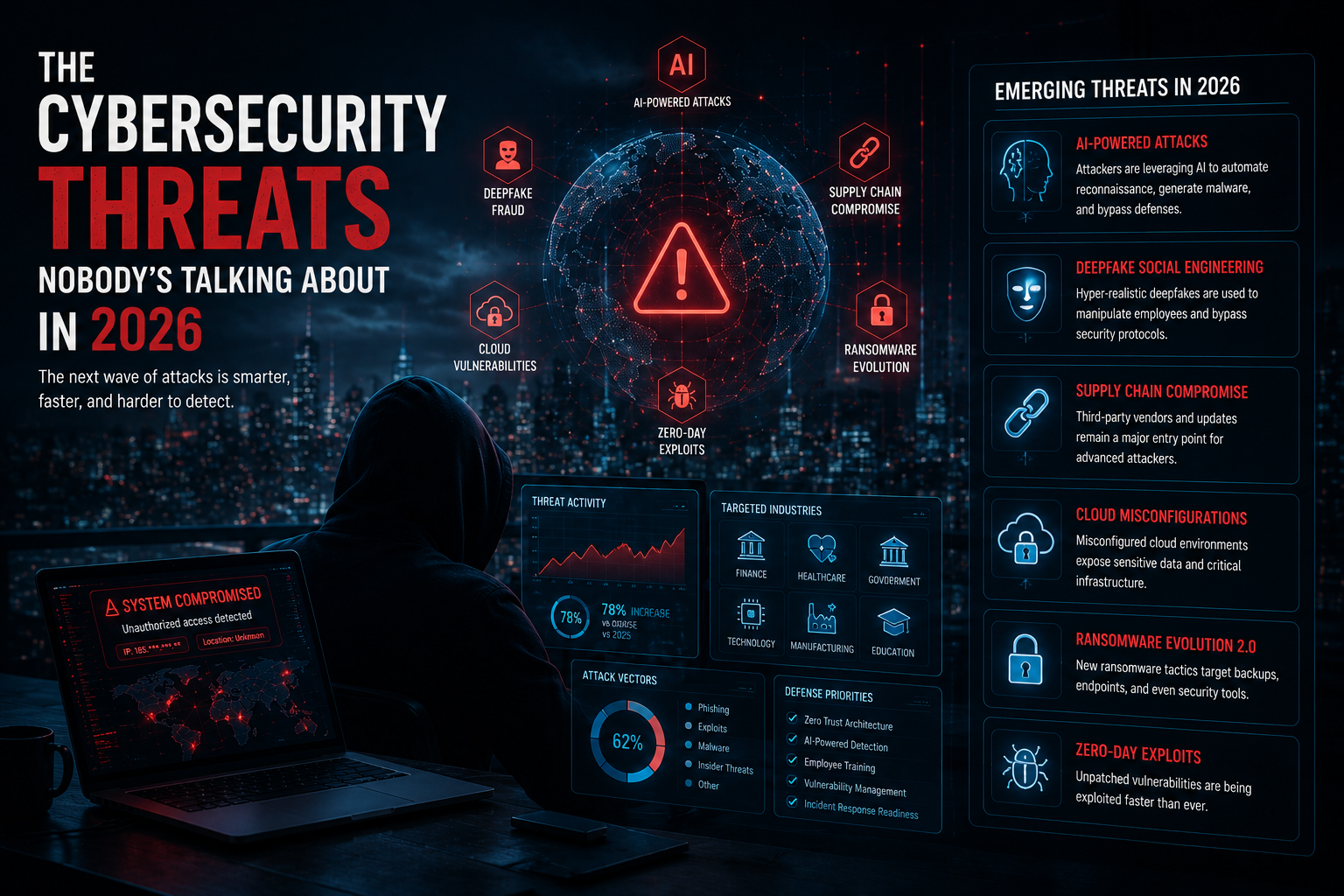
The Cybersecurity Threats Nobody’s Talking About in 2026
Everyone’s talking about ransomware. Phishing. Data breaches.
Those are real. They’re also the threats that every security vendor has been selling protection against for the last decade. Your IT team knows about them. Your insurance provider asks about them. There’s a playbook.
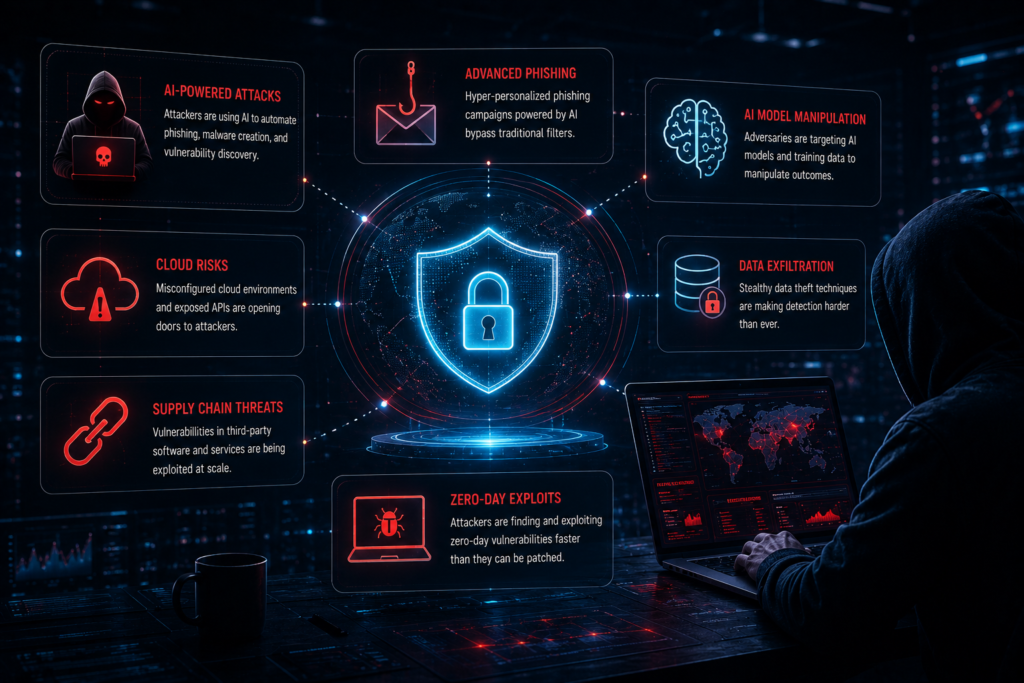
The threats worth worrying about in 2026 are the ones that don’t have a mature playbook yet. The ones that are moving faster than enterprise security teams can respond. The ones that exploit the new attack surface created by AI, automation, and the shift in how companies operate.
Here’s what’s actually keeping serious security people up at night — and not getting nearly enough coverage.
AI-Powered Social Engineering
Phishing has always worked because it exploits human psychology. What’s changed is the quality.
A year ago, AI-generated phishing emails were detectable. Odd phrasing. Generic context. Something that felt slightly off. That’s no longer reliably true.
The new generation of AI-powered social engineering attacks uses publicly available information — LinkedIn profiles, company websites, recent press releases, social media — to craft messages that are contextually specific, tonally accurate, and genuinely convincing. An email that references your actual project, your actual manager’s name, and a real business situation you’re involved in is a different problem than a generic “your account has been compromised” message.
Voice cloning has made this worse. A phone call from what sounds exactly like your CFO asking you to approve an urgent wire transfer is not a theoretical threat. It’s happening. The audio quality has crossed the threshold where most people can’t reliably distinguish it from a real call.
The multi-agent AI systems that are reshaping how businesses operate are also reshaping how attackers operate. Automated, personalised attacks at scale is now a capability with a low barrier to entry.
Shadow AI and the Data Exposure Problem
Every company has employees using AI tools that IT doesn’t know about.
This isn’t speculation. It’s the default state of every organisation that hasn’t explicitly addressed it. Someone pastes a customer contract into ChatGPT to get a summary. Someone uploads a financial model to an AI tool to ask questions about it. Someone uses a browser extension that sends their email content to a third-party server.
None of these people are being malicious. They’re trying to do their jobs faster. And in doing so, they’re sending sensitive data to systems outside the company’s security perimeter — systems with their own data retention policies, their own breach risk, their own terms of service that nobody read.
The threat here isn’t the AI. It’s the gap between how employees are actually working and what the security policy assumes they’re doing. That gap is large and growing.
Automated Vulnerability Discovery
The same AI capabilities that make developers more productive are making attackers more productive.
Finding vulnerabilities in software used to require skilled human researchers spending significant time on specific targets. AI-assisted vulnerability discovery changes the economics. Automated systems can scan codebases, identify potential weaknesses, and prioritise the ones most likely to be exploitable — faster and at lower cost than before.
The asymmetry this creates is uncomfortable. Defenders need to protect everything. Attackers only need to find one thing. AI makes the attacker’s job faster without making the defender’s job proportionally easier.
This connects to something important about how technology advances change the threat landscape — new capabilities don’t arrive neutrally. They arrive asymmetrically, and security teams are often on the wrong side of the asymmetry.
Supply Chain Attacks Getting Smarter
The SolarWinds attack in 2020 demonstrated that compromising a trusted software vendor is a more effective path into thousands of organisations than attacking each one directly. That lesson has been absorbed — by attackers.
Supply chain attacks in 2026 are more sophisticated in two ways.
First, the targeting is more precise. Rather than broad compromise of a widely-used tool, attackers are identifying specific dependencies used by specific high-value targets and compromising those. Smaller blast radius, harder to detect, more focused damage.
Second, AI-generated code is creating a new supply chain risk that barely existed two years ago. Code generated by AI tools and incorporated into production systems without full human review can contain vulnerabilities — either introduced accidentally or, in more concerning scenarios, introduced deliberately through compromised training data or poisoned model outputs.
Most organisations don’t have a clear answer to “how much of our production code was AI-generated and how thoroughly was it reviewed?” That’s a gap that matters.
The Quantum Decryption Timeline Is Closer Than You Think
This one moves slowly and then suddenly.
Quantum computing crossed a commercial threshold in 2026 that changes the cryptographic risk calculus. Fault-tolerant quantum systems capable of breaking current encryption standards aren’t here yet — but the timeline for when they will be is compressing.
The attack model that makes this urgent now — before quantum computers can actually break encryption — is harvest now, decrypt later. Attackers are collecting encrypted data today, storing it, and waiting for the quantum capability to catch up. Data that needs to remain confidential for five to ten years is already at risk from this model.
NIST finalised post-quantum cryptographic standards in 2024. Most organisations have not begun migration. The window to do this in an orderly, planned way is narrowing. Doing it in a crisis is much more expensive.
Identity-Based Attacks in a World of AI Agents
As companies deploy more AI agents — systems that operate autonomously with access to real tools, real data, and real systems — the identity attack surface expands significantly.
An AI agent that has access to your CRM, your email, your financial systems, and your project management tool is a high-value target. If an attacker can compromise the agent’s credentials, inject malicious instructions into its context, or manipulate its behavior through carefully crafted inputs, they have access to everything the agent can access.
This is a new category of threat that most security frameworks weren’t designed to address. The question of what AI employees actually are has a security dimension that most deployments are ignoring: an AI agent is a privileged identity in your system, and it needs to be treated like one.
Prompt injection — manipulating an AI agent’s behavior through malicious content it processes — is the specific attack vector that’s most underappreciated right now. An agent that reads emails, summarises documents, or browses the web can be manipulated by content it encounters in those sources. The controls for this are still immature.
What to Actually Do
The threats above share a common theme: they exploit new attack surfaces that traditional security frameworks weren’t designed for.
The practical response isn’t panic. It’s clarity about where the new exposure actually is.
Audit your AI tool usage. Find out what AI tools your employees are actually using — not just the ones IT approved. Understand what data is being sent where.
Treat AI agents as privileged identities. Apply the same access controls, monitoring, and review processes to AI agents that you apply to human users with elevated access.
Start the post-quantum migration conversation. Even if full migration is years away, understanding your cryptographic exposure now is the prerequisite for planning.
Invest in voice authentication protocols. For high-stakes financial or operational decisions, establish out-of-band verification processes that don’t rely on voice or video alone.
Review your software supply chain. Know your dependencies. Know where AI-generated code is in your production systems and what review it received.
The cybersecurity threats getting the most attention in 2026 are real. So are the ones that aren’t getting enough.
The ones above are moving faster than most enterprise security programs are adapting. That gap is where the serious incidents of the next two years will come from.