
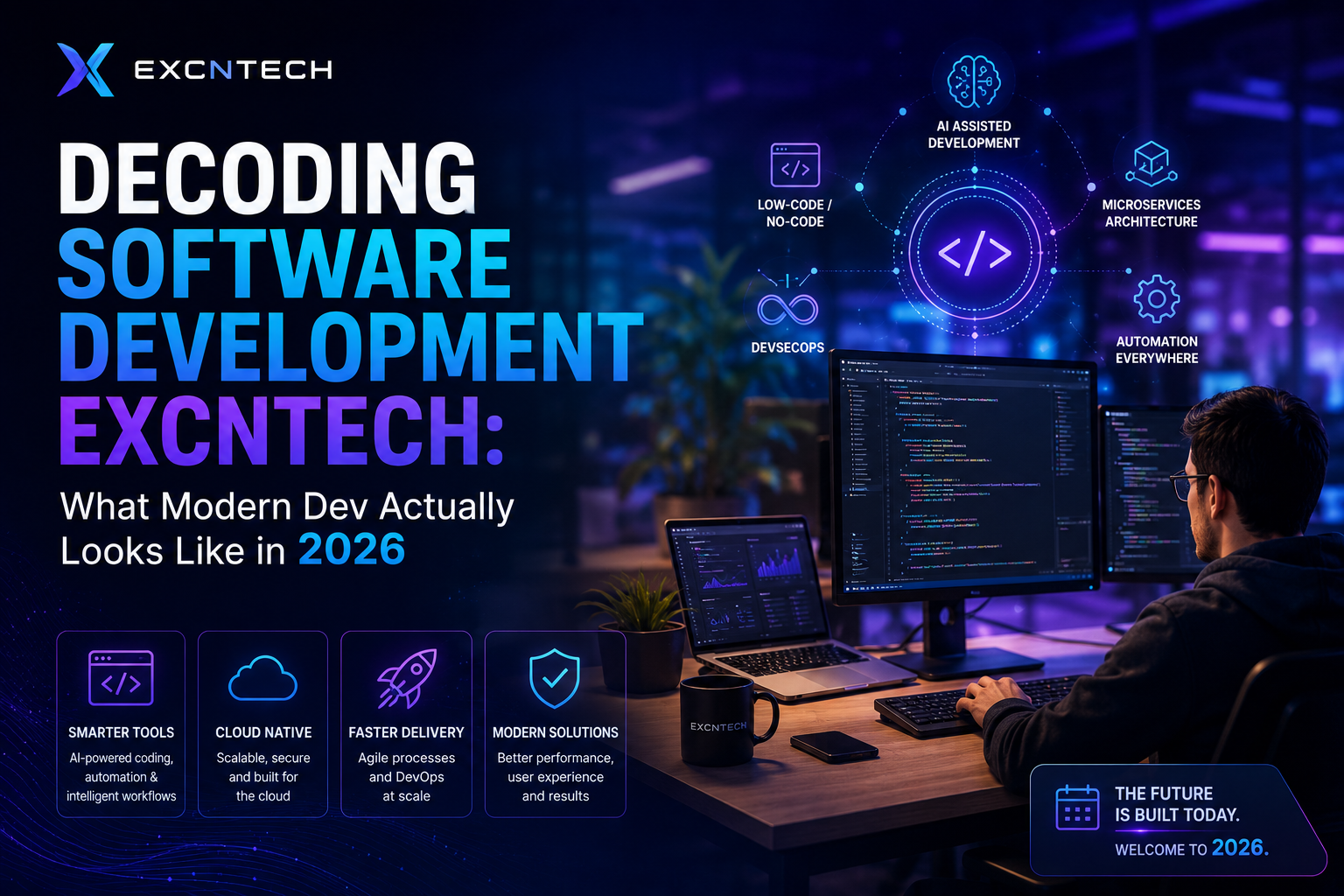
Modern Software Development in 2026: What Actually Changed (and What Didn’t)
Software development in 2026 looks nothing like it did five years ago.
Not because the fundamentals changed — they didn’t. Clean code still matters. Testing still matters. Documentation still matters. Architecture decisions still have consequences that outlast the sprint they were made in.
What changed is the layer on top. The tools. The workflow. The ratio of human thinking to AI execution. Understanding modern software development means understanding that layer — what’s actually different, what it requires from developers, and what hasn’t changed despite the noise.
Futurelume — covering what’s actually happening in tech
What “Modern Software Development” Actually Means
The phrase gets used loosely. Here’s what it actually points at in 2026.
AI is embedded in the development workflow, not optional. Developers using GitHub Copilot, Cursor, or similar tools aren’t early adopters anymore — they’re the default. The question isn’t whether to use AI assistance in development, but how to use it without creating the problems it was supposed to solve.
Agentic AI is moving from experimental to production. AI systems that can trigger CI/CD pipelines, write and run tests, suggest architectural changes, and catch bugs before human review are real. Not in every team, not reliably enough to trust without oversight. But real, and getting more capable every quarter.
The orchestration skill matters as much as the coding skill. The developers who are most effective right now aren’t necessarily the best coders in the traditional sense. They’re the best at knowing what to ask AI to do, what to verify carefully, and what still requires pure human judgment.
This is the shift in modern software development: from writing code line by line to orchestrating a workflow where humans and AI tools each do what they’re best at.
What Still Matters — And Gets Undervalued
Here’s what gets lost in the AI tooling conversation.
Maintainability over cleverness. Clean code that looks beautiful but breaks when you touch it is not good code. The measure that matters is: can this be changed safely in six months by someone who didn’t write it? AI generates code that often looks correct and is harder to maintain than hand-written code, precisely because it’s optimized for the immediate task rather than the long-term system.
Understanding what the AI generated. The most dangerous developer in 2026 is the one who pastes AI-generated code into production without understanding it. Not because the code is wrong — it’s often right. Because when it’s wrong, and when it breaks under conditions the prompt didn’t anticipate, the developer who doesn’t understand it can’t fix it.
Architecture decisions before implementation. AI is excellent at implementing. It’s poor at deciding what should be implemented and why. The decisions about system structure, data models, API boundaries, and service decomposition still require human judgment — and they’re more consequential than ever, because AI can implement a bad architectural decision very quickly and very thoroughly.
Testing that covers the full pyramid. Unit tests. Integration tests. End-to-end tests. AI can help write them. It doesn’t decide what to test, what edge cases matter, or what failure modes are worth catching. That judgment still belongs to the developer.
The AI Tools Worth Knowing in 2026
| Tool | What It Does Best | What It Doesn’t Do |
|---|---|---|
| GitHub Copilot | In-IDE code completion, documentation | Understands your full system context |
| Cursor | Full codebase AI interaction, iterative development | Architectural decision-making |
| Claude / GPT-4o | Complex reasoning, code review, debugging help | Replace understanding with output |
| Devin / similar agents | End-to-end task execution | Handle ambiguous requirements |
| SonarQube + AI | Automated code quality and security scanning | Creative problem-solving |
The best LLMs in 2026 for coding differ from the best LLMs for writing or analysis — Claude and Cursor’s underlying models tend to produce cleaner, more maintainable code with better instruction following on complex tasks.
The Workflow That Actually Works
The developers getting the most from AI tooling in 2026 follow a consistent pattern — not because they read about it, but because they discovered it works.
Define before generating. Before prompting an AI tool to write code, write down in plain language what the code needs to do, what it needs not to do, and what the edge cases are. The time spent on this is recovered in the reduced time spent fixing wrong outputs.
Read before committing. Every AI-generated code block gets read — not skimmed, read — before it goes into a commit. If you can’t explain what it does, you can’t commit it. This sounds slower. It’s faster when the alternative is debugging AI-generated code you don’t understand three weeks later.
Test immediately. AI-generated code gets tested immediately, in isolation, before it’s integrated. Edge cases get tested explicitly. The optimism that “it probably works” is the source of most AI-assisted development problems.
Document why, not what. AI can generate code comments that describe what code does. Only humans can explain why architectural decisions were made. The documentation that matters in an AI-assisted codebase is the decision log — why this approach, what alternatives were considered, what the known limitations are.
The Version Control Discipline That Gets Skipped
This one comes up in almost every “decoding software development” conversation and almost never gets enough attention.
Modern software development requires more Git discipline than before, not less. When AI generates code quickly, the temptation is to commit large changes that mix multiple concerns. This makes code review harder, makes debugging harder, and makes rollback harder.
The discipline that works:
- Atomic commits — one logical change per commit
- Imperative commit messages — “Add user authentication middleware” not “updated some files”
- Trunk-based development or GitFlow depending on release cadence — but consistently applied
- Mandatory quality gates in CI/CD — linting, security scanning, test coverage
Mandatory quality gates before any merge aren’t optional in 2026. Not because of process compliance. Because AI-generated code that looks correct contains subtle issues often enough that automated scanning is the last line of defense before it reaches production.
The Skill That Compounds
The developers who will be most valuable in 2030 are developing a specific skill right now: the ability to work effectively with AI tools while maintaining genuine understanding of what those tools are producing.
This isn’t the same as being the best prompt engineer. It’s the ability to use AI to go faster without losing the understanding that makes you able to debug, maintain, and architect systems when the AI produces something wrong.
The future of work changes are real in software development as much as anywhere. The developers who adapt aren’t the ones using the most AI — they’re the ones who understand what they’re orchestrating.
Understanding software development in 2026 means understanding that the workflow changed, the tools changed, and the ratio of human-to-AI work changed — but the fundamentals didn’t. Maintainability. Testing. Architecture. Documentation. Understanding what you ship.
The developers who are thriving right now are faster than they were, but they’re not understanding less. They’re applying judgment earlier in the process, letting AI handle more of the execution, and being more rigorous about verification than they had to be before.
That’s the actual shift.