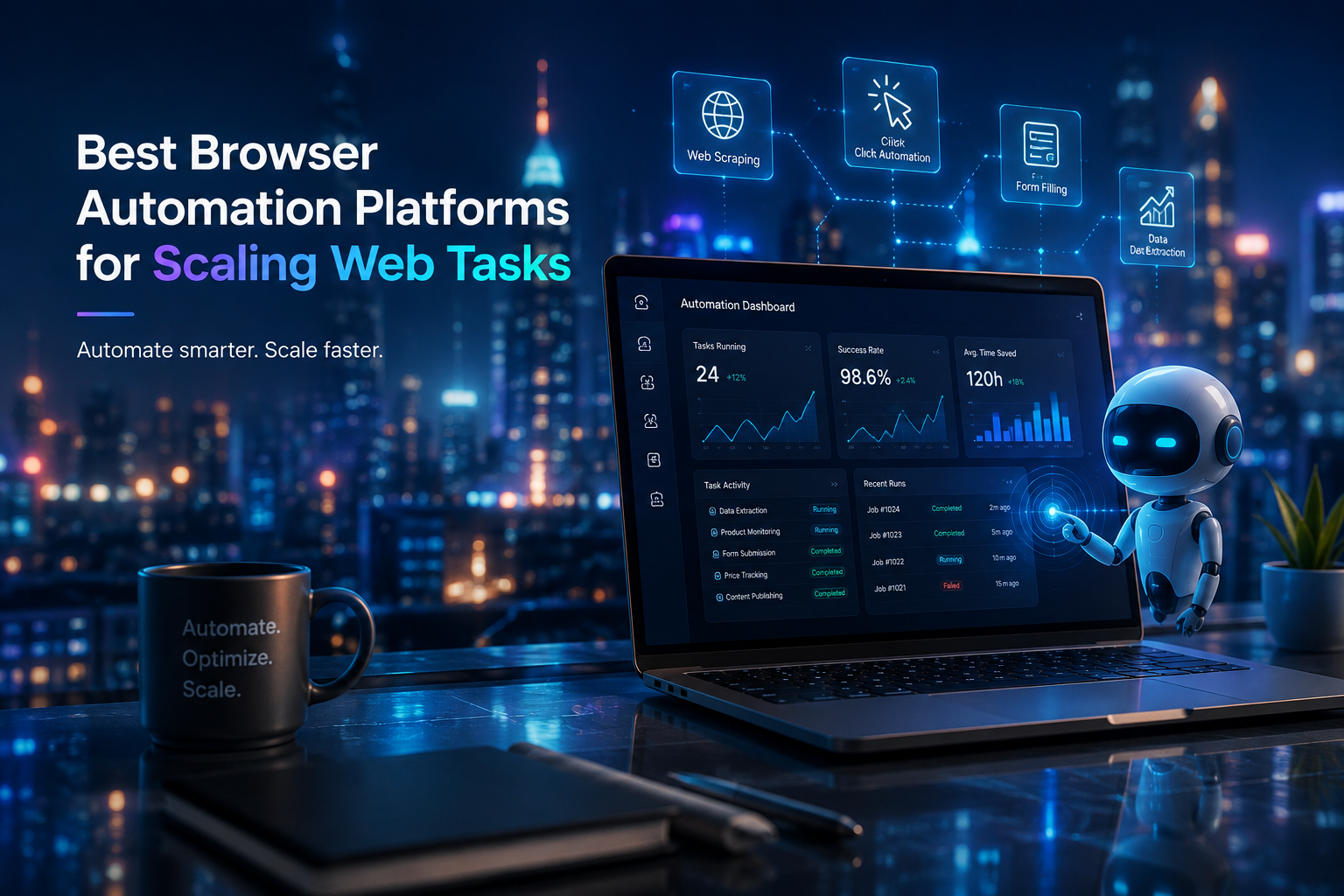
Best Browser Automation Platforms for Scaling Web Tasks
We tested this AI platform to evaluate its features, usability, pricing, and overall value for different types of users.

What Are Browser Automation Platforms?
Browser automation platforms let you record or script repetitive web actions — logging in, filling forms, clicking through pages, pulling data — and replay them automatically across many browser sessions at once.
For businesses running high-volume tasks like price monitoring, lead scraping, or multi-account management, they unlock serious leverage: work that used to take a team hours now runs unattended, on a schedule, at a fraction of the cost.
The category splits into two real camps in 2026. On one side are the veteran, code-adjacent platforms — tools like ZennoPoster — built years before “AI agent” was a marketing term, designed around visual workflow logic and raw multi-threaded execution. On the other side are the newer AI-driven browser agents that let you describe a task in plain English and get a working automation in minutes, trading some raw power and scale for a dramatically shorter setup time.
Neither camp is objectively better. The right choice depends entirely on your volume, your timeline, and how much setup time you’re willing to trade for long-term capability. That trade-off is the thread running through every platform in this comparison.
Top Browser Automation Platforms Compared
| Platform | Best For | Ease of Use | Threads / Scale | Pricing | Overall |
|---|---|---|---|---|---|
| ZennoPoster | High-volume scraping & automation | ★★☆☆☆ | 100+ threads | $37+/mo | 4.6/5 |
| actlike.me | No-code AI browser agent | ★★★★★ | Credit-based | Free–$49/mo | 4.4/5 |
| Browzey | One-click task automation | ★★★★☆ | Moderate | $25+/mo | 4.2/5 |
| UiPath | Enterprise-grade RPA | ★★★☆☆ | Very high | Custom / Enterprise | 4.3/5 |
| Octoparse | Simple data scraping | ★★★★☆ | Low–moderate | $75+/mo | 4.0/5 |
Ratings based on hands-on testing, feature depth, ease of use, and value.
A quick note on how to read this table: “ease of use” and “threads/scale” pull in opposite directions almost everywhere in this category. The platforms that are fastest to pick up — actlike.me, Browzey — trade away the raw thread counts and deep customization that high-volume scraping eventually demands. The platforms built for scale — ZennoPoster, UiPath — ask for a real time investment up front. There’s no free lunch here, and any review that implies otherwise is oversimplifying.
A Closer Look at Each Platform
ZennoPoster — Best for scale
- The platform this comparison keeps circling back to, and for good reason: it’s the only tool here that comfortably handles hundreds of parallel browser threads without falling over.
- Automates a real, rendered browser rather than firing raw HTTP requests, which makes it noticeably harder for target sites to detect than lightweight scraping scripts.
- The cost is a genuinely dated interface and a setup process that took several days even with prior scraping experience.
- Vendor figures put the install base above 200,000 customers across 126 countries, with an active community trading templates — a tool people stick with once they learn it, not one they abandon after a trial.
actlike.me — Best for fast setup
- Sits at the opposite end of the spectrum: describe what you want done in plain English, and its AI browser agent handles navigation, form-filling, and data extraction on its own.
- Setup is measured in minutes, not days.
- The trade-off is scale: built around a credit system rather than raw thread counts, a poor fit for anything approaching thousands of records.
- Excellent fit for lighter, recurring tasks that don’t justify a steep learning curve.
Browzey — Best for simple recurring tasks
- Occupies a similar niche to actlike.me — one-click automation for repetitive web tasks, with scheduling built in for recurring jobs.
- Less AI-forward in how it interprets tasks, leaning more on pre-built workflow templates.
- A touch more predictable, but a touch less flexible for unusual sites.
UiPath — Best for enterprise
- The enterprise answer to this whole category: matches or exceeds ZennoPoster on raw scale, with far more polish.
- Priced and packaged for corporate IT teams with dedicated automation staff, not individual operators or small teams moving fast.
Octoparse — Best for simple scraping
- The simplest tool on this list, and that’s its selling point.
- If your task is straightforward structured scraping — no complex logins, no multi-step workflows — it gets there faster than anything else here.
- Not built to handle the kind of high-volume, multi-site, multi-thread work that pushes people toward ZennoPoster or UiPath in the first place.

FUTURELUME TIP
Start with one workflow, not your whole pipeline.
Pick the platform that fits your task’s complexity, not the one with the most features. Build one high-volume scenario, validate the output, then expand thread count and scope step by step.
Why Browser Automation Matters for Growing Teams
Move faster
Ship data pipelines and repetitive workflows without adding headcount.
Save more
Save moreReplace hours of manual data entry and monitoring with unattended runs.
Scale smarter
Run hundreds of parallel threads so your team focuses on analysis, not clicking.
Key Features to Look For

Key Features to Look For
✓Multi-threaded execution that scales with your volume
✓Built-in or easily integrated proxy management
✓Browser-level automation, not just raw HTTP requests
✓Reliable scheduling for unattended, recurring runs
✓Active community or template library for common use cases
One feature that doesn’t make most checklists but should: how a platform behaves when something breaks. A site changes its layout, a proxy gets blacklisted, a login page adds a new CAPTCHA — these aren’t edge cases, they’re inevitabilities once you run anything long enough at scale. The platforms that survive that moment gracefully (clear error logs, retry logic, an alert instead of silent failure) save you far more time over a year than any single feature on a spec sheet.
Setup Tips From Our Testing
We ran real scenarios across several of these platforms before writing this comparison. Here’s what actually saved us time — and what cost us time we didn’t need to lose.
| # | Tip | Why It Matters |
|---|---|---|
| 1 | Start with a template close to your use case | Reading a working scenario teaches the logic faster than documentation alone |
| 2 | Test with 1–2 threads before scaling up | Bugs invisible at low volume become chaos at 50+ threads |
| 3 | Build in a failure alert (Telegram, email, Slack) | Unattended runs fail silently unless you tell the platform to speak up |
| 4 | Budget proxy costs separately from the software price | For scraping at real volume, proxies often cost more than the platform itself |
| 5 | Don’t trust community templates blindly | Outdated selectors can return empty data without throwing an error |
| 6 | Run early schedules supervised, not unattended | Catches logic errors before they quietly corrupt a week of data |

OUR VERDICT
ZennoPoster takes the lead for scale
ZennoPoster is our top pick for teams that need serious volume — hundreds of threads, real browser-level automation, and nearly two decades of community-built templates behind it. The tradeoff is a steeper learning curve than newer AI-driven tools, but for high-volume scraping and automation, nothing else matches its raw power at the price.

Frequently Asked Questions
Is ZennoPoster still worth learning in 2026, with AI agents available?
Yes, if your volume justifies it. For a few hundred repeated actions or fewer, a lighter AI-driven tool like actlike.me will get you there faster. Past that volume, ZennoPoster’s threading and stability are hard to match at the price.
Do any of these platforms work without coding knowledge?
The AI-driven tools (actlike.me, Browzey) are built for this. ZennoPoster and UiPath are usable without code for basic scenarios, but unlocking their full power eventually pushes you toward at least light scripting.
Which platform is cheapest for a small, one-off task?
Octoparse or Browzey, generally — the setup time on ZennoPoster or UiPath isn’t worth it unless the task recurs and scales.
Can I switch platforms later as my needs grow?
Yes, and it’s a common path — many teams start on a lighter AI-driven tool and move to ZennoPoster or UiPath once volume outgrows what the lighter platform can handle.