
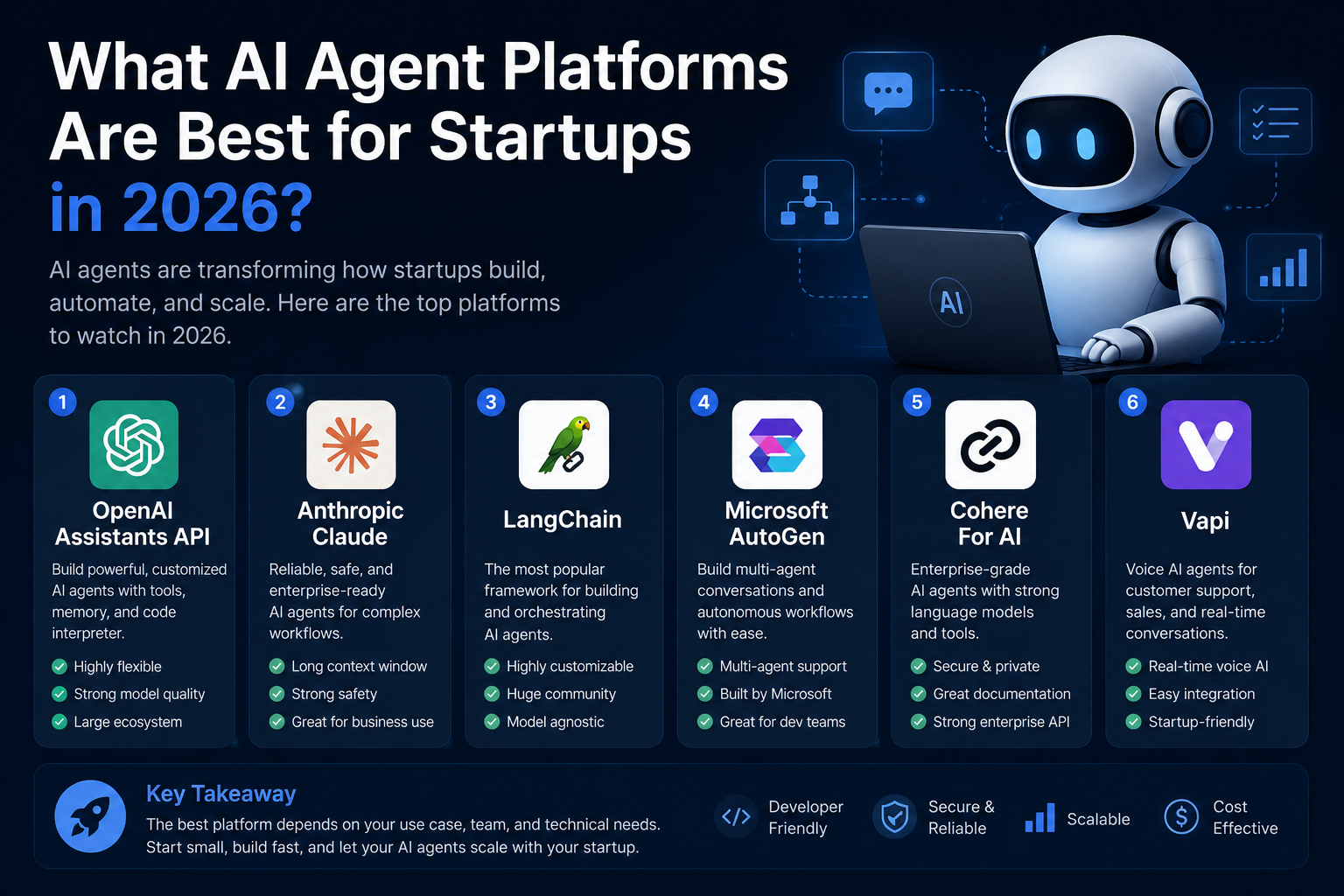
What AI Agent Platforms Are Best for Startups in 2026?
The AI agent platform market has a startup problem.
Most platforms are built for two audiences: developers who want full control and enterprises that want governance. Startups — who need fast time-to-value, low technical overhead, affordable pricing, and room to grow — are caught between tools that are too complex and tools that are too limited.
The honest answer to “what’s the best AI agent platform for a startup?” depends on one question first: does anyone on your team want to design agents, or do you want agents that are already built?
That fork in the road determines your entire shortlist.
The Two Paths
Path 1: Build your own agents. You have someone technical (or willing to learn) who can spend time configuring workflows. You want flexibility to handle your specific use case. The tools here give you control at the cost of setup time.
Path 2: Deploy pre-built agents. Nobody owns automation as a job. You need results this week, not this quarter. The tools here remove the design step and get you running faster with less control.
Most startups overestimate how much they want Path 1. They pick the flexible platform, discover nobody has time to configure it, and it sits half-implemented while they fight other fires.
Path 1: Build Your Own — Best Platforms for Startup Teams
n8n — Best for Technical Founders Who Want Control
n8n is the open-source workflow automation platform that’s evolved into a capable AI agent builder. Self-hosting is a major differentiator — for startups handling sensitive data who need control over where information lives, n8n offers something most cloud platforms can’t.
The 400+ pre-built connectors cover most integrations, and you can call any API directly. The learning curve is steeper than pure no-code platforms, but if someone on your team is comfortable with basic technical concepts, n8n is the most powerful startup-accessible option.
Pricing: Free self-hosted. Cloud from $20/month. Execution-based pricing that scales predictably.
Best for: Technical teams that want flexibility and data control. Startups in regulated industries that need self-hosted infrastructure.
Make (formerly Integromat) — Best Middle Ground
Make has been popular with freelancers, solo operators, and startups for its wide range of integrations and affordable price. It sits between Zapier (simpler but pricier) and n8n (more powerful but steeper learning curve).
The AI Agents feature now allows goal-driven agents that adapt in real time rather than following rigid pre-defined workflows. With 3,000+ pre-built integrations, if you’re already using standard tools, Make probably connects to them.
Pricing: Free tier. Paid from $9/month. Operations-based pricing — predictable for low-to-medium volumes.
Best for: Startups that want visual workflow building with AI agent capability at accessible pricing.
Lindy — Best No-Code Agent Builder
Lindy is designed for teams who want workflow flexibility without writing code. It handles multi-step agents with a visual interface that non-developers can configure.
For startups where the founder or an ops generalist needs to own automation without engineering support, Lindy covers the most common use cases — calendar management, email handling, CRM updates, research — without requiring technical implementation.
Best for: Small teams without dedicated engineering. Founders who want to own automation themselves.
Path 2: Deploy Pre-Built — Best Platforms by Use Case
Sales and Outreach: 11x or Reply
For startups running outbound sales, AI SDR platforms handle the entire prospecting loop — research, targeting, message generation, and follow-up — as a single continuous agent workflow. The value for a startup is removing the hidden labor cost of managing sequences: no list to build, no template to approve, no cadence to monitor.
The output is booked meetings, not activity metrics — which aligns directly with what an early-stage startup actually cares about.
Customer Support: Intercom Fin AI
Intercom Fin AI is designed for SaaS and growth-stage startups that want quick deployment and a polished customer experience without heavy setup. The Fin AI agent handles tier-one support automatically, with seamless handoff to human agents for complex issues.
For a startup where a two-person team is handling a support volume that would otherwise require five people — this is the right tool before you can afford to hire.
E-Commerce Support: Gorgias
If your startup sells physical products through Shopify, Gorgias connects natively to your store data and auto-resolves order status, tracking, and return queries with real order information — not generic scripted responses that still need a human follow-up.
For DTC startups, this eliminates the largest category of repetitive tickets before your first support hire.
The Comparison That Actually Helps
| Platform | Technical Req. | Time to Value | Pricing Model | Best For |
|---|---|---|---|---|
| n8n | Medium-High | Days-weeks | Free / $20mo+ | Technical founders, data control |
| Make | Low-Medium | Hours-days | From $9/mo | Visual builders, wide integrations |
| Lindy | Low | Hours | Subscription | Non-technical founders |
| Intercom Fin | Low | Days | Per resolution | SaaS customer support |
| Gorgias | Low | Days | Per ticket | E-commerce support |
| 11x / Reply | Low | Days | Per seat/outcome | Outbound sales |
The Pricing Reality
The AI agent platform market has four distinct pricing models — and they behave very differently as you scale:
Per seat — predictable, scales with team size. Watch for: per-seat pricing gets expensive as you add users.
Per task/execution — pay for what you use. Watch for: unpredictable at high volumes.
Per outcome — pay per conversation, resolution, or meeting booked. Watch for: compounds unexpectedly as containment improves.
Flat subscription — predictable monthly cost regardless of volume. Watch for: credit limits that reset monthly without rollover.
For startups, execution-based or flat subscription models are usually most predictable early on. Per-outcome models can be compelling if the agent replaces a clear per-unit cost, but they require careful modeling before you scale.
What Matters More Than Platform Choice
The AI agent market reached $7.84 billion in 2025 and is growing at nearly 50% annually through 2030. Getting from 80% accuracy — sufficient for pilots — to 99%+ required for production can take 100x more development work than initial setup. This is why most startup AI agent failures happen not because the platform was wrong but because the use case wasn’t right.
The AI agent tools comparison covers the broader landscape. For startups specifically: choose the platform that matches your team’s technical capacity, not the platform with the most impressive feature list. The tool your team actually uses is the tool that delivers value.
Related Reading on FutureLume
- Best AI Agent Orchestration Platforms in 2026: Who’s Actually Coordinating Multi-Agent Workflows
- AI Hardware Startups: Companies Building the Future of Compute in 2026
- AI Startups 2026: What’s Actually Working and What’s Already Dead
- Best SaaS Tools for Startups in 2026: What’s Actually Worth the Monthly Fee