Agentic AI Development Services: What They Cost and What You’re Actually Buying in 2026
The agentic AI market is projected to reach nearly $10.91 billion in 2026 and grow to over $180 billion by 2033 — but that explosive growth is colliding with a messier reality on the ground: industry data puts agentic AI project overruns at 35–50% above initial estimates, significantly higher than typical software projects. Before hiring an agentic AI development services provider, it’s worth understanding exactly what drives that cost variance, because “agentic AI” covers everything from a simple scripted chatbot to a governed, multi-agent enterprise platform — and vendors routinely quote wildly different numbers because they’re scoping entirely different things.
What “Agentic AI” Actually Means (and Why Vendors Quote So Differently)
The term “AI agent” can describe anything from a simple assistant to a governed, multi-system business application — which is exactly why agentic AI development cost estimates vary so much between vendors. A tighter way to scope any project is the four-factor filter: volume, rules, system access, and measurability. The more a task involves high volume, clear rules, broad system access, and measurable outcomes, the better suited it is to an agentic approach — and the more precisely a vendor should be able to price it.
Agentic AI Development Cost by Complexity Tier
| Tier | What It Includes | Typical Cost Range |
|---|---|---|
| Simple / Task-Specific Agent | Single-purpose bot, basic tool-use, limited integrations, light fine-tuning | $15,000 – $40,000 |
| Advanced Agentic AI | Multi-step reasoning, custom fine-tuned model or vector DB, complex API connections, workflow orchestration and memory | $40,000 – $90,000 |
| Enterprise-Grade Agentic AI | Multi-agent collaboration, domain-specific large-scale fine-tuning, real-time decision systems, full security and compliance controls | $90,000 – $400,000+ |
| Fully Autonomous Enterprise Platform | Multi-agent orchestration, memory, human-in-the-loop guardrails, full compliance controls | Routinely exceeds $1,500,000 |
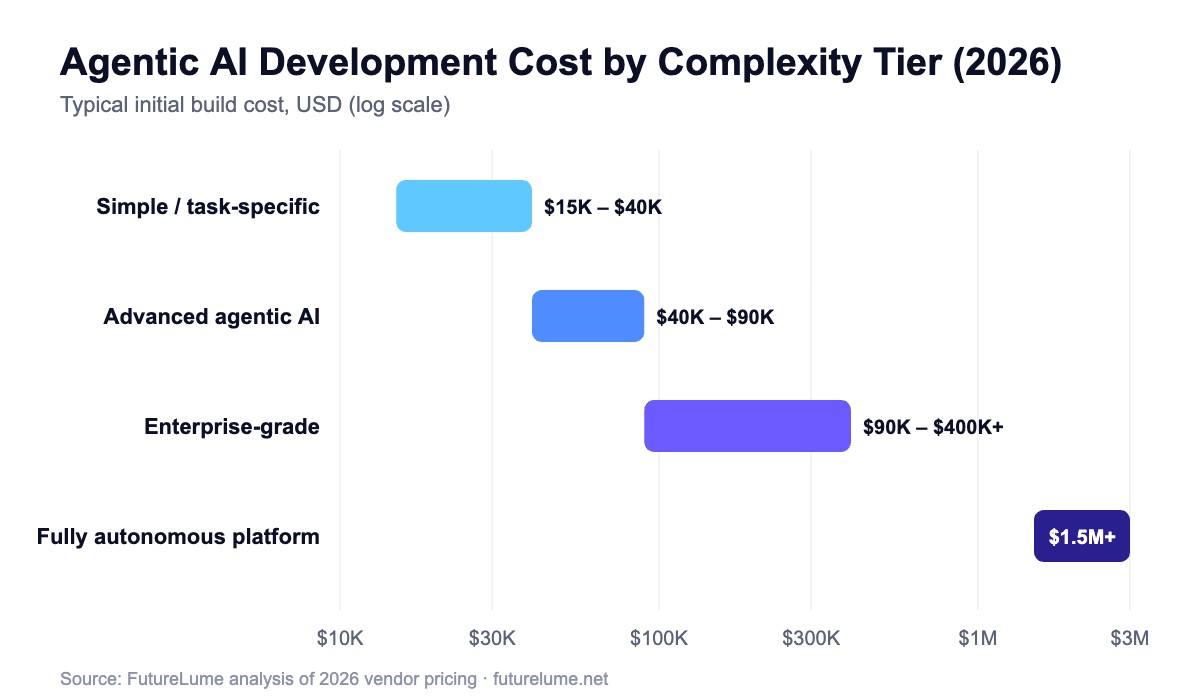
Figures reflect multiple 2026 industry pricing guides; actual quotes vary by vendor, region, and integration depth.
Cost by Industry and Compliance Tier
Compliance isn’t a layer added at the end of an agentic AI build — it’s a cost driver baked into the architecture from day one, and it’s the single biggest reason healthcare and financial services projects cost multiples of a simple customer-support agent:
- Customer support agents — typically $30,000–$90,000, benefiting from well-defined intents, clear escalation paths, and mature tooling that keeps costs lower and ROI timelines to 3–6 months.
- Financial services agents (fraud detection, compliance reporting, trading support) — $120,000–$500,000+, driven by regulatory compliance, audit trails, and real-time data feeds.
- Healthcare agents (patient intake, clinical documentation, prior auth) — $150,000–$400,000+, driven by HIPAA requirements, PHI handling, and clinical accuracy validation.
- Professional services agents (research, document review, proposal automation) — $60,000–$250,000, driven by knowledge retrieval accuracy and multi-source integration.
The Ongoing Cost Nobody Mentions Upfront
The build price is only part of the story. Ongoing maintenance and support commonly adds 15–25% of the original development cost annually — and real published vendor pricing shows this can run considerably higher for production systems. A few real data points from published 2026 vendor contracts:
| Vendor Example | Initial Build | Ongoing Cost | First-Year Total |
|---|---|---|---|
| Enterprise production agent | $40,000–$150,000 | $8,000–$25,000/month | $96,000–$300,000 |
| Mid-size implementation | $18,000 | $4,500/month | ~$54,000 |
| Lightweight quick build | $2,500–$5,000 | $1,000–$2,500/month | $12,000–$30,000 |
LLM API usage alone typically runs $1,000–$5,000/month for an active production agent, separate from any vendor support retainer. Budget for this as an ongoing operating expense, not a one-time cost — a system that looks affordable at launch can become expensive to run at real volume if token usage wasn’t modeled upfront.
Build vs. Buy: A Real Decision Point
Not every use case justifies a custom agentic AI development engagement. For lower-volume, well-defined workflows, an off-the-shelf AI automation tool is often the more practical starting point — you can prototype one for little or nothing (several frameworks offer free tiers, and no-code platforms start around $20–35/month). Reserve custom development for cases where the four-factor filter — volume, rules, system access, measurability — clearly points toward a bespoke build justifying its cost. If you want to experiment before engaging agentic AI development services, start with our guide to the OpenAI Agents API or our comparison of the best AI agent orchestration platforms.
Questions to Ask Agentic AI Development Services Vendors Before You Sign
- What exactly is included in the quoted price — discovery, build, integration, and testing, or just the core agent? Published vendor data shows discovery/scoping alone can run $5,000–$15,000 as a separate line item.
- What’s the ongoing monthly cost once the agent is live, including both model API usage and vendor support? Get this as a specific number, not a vague percentage.
- How do you handle prompt degradation over time? Agentic AI systems don’t stay sharp on their own — ask specifically how the vendor monitors and corrects for this as usage patterns shift.
- What human-in-the-loop checkpoints are built in for consequential actions? This should be a defined part of the architecture, not an afterthought added after a costly mistake.
- What security and compliance controls are included, and which are considered add-ons? For regulated industries, confirm this before comparing price across vendors — a lower quote that excludes compliance work isn’t actually cheaper.
- How long does a comparable project typically take, end to end? A simple assistant-style agent might take 2–6 weeks; regulated multi-agent deployments take considerably longer and should be delivered in phased implementations with testing gates.
Frequently Asked Questions
What’s the difference between an AI agent and agentic AI?
A basic AI agent typically handles a single, well-defined task with limited autonomy — a build cost of roughly $15,000–$80,000. Agentic AI implies broader autonomy, multi-step reasoning, and often multi-agent coordination, with build costs typically ranging from $60,000 to $400,000+ and meaningfully higher ongoing run costs.
Why do agentic AI development quotes vary so much between vendors?
Because the term covers everything from a simple scripted assistant to a governed, multi-agent enterprise platform. Use the four-factor filter — volume, rules, system access, measurability — to make sure you’re comparing vendors who are scoping the same type of system, not wildly different ones under the same label.
How long does it take to build an agentic AI system?
A simple, assistant-style agent can take roughly 2–6 weeks. Advanced multi-tool agents typically run 8–20 weeks, and regulated, enterprise-grade multi-agent systems commonly take 6–18 months depending on compliance requirements and integration depth.
Should I build a custom agentic AI system or use an off-the-shelf automation tool?
For lower-volume or simpler workflows, an off-the-shelf tool is usually the more practical and cost-effective starting point. Custom development is justified when the task involves high volume, complex rules, deep system access, and clearly measurable outcomes that a generic platform can’t handle well.