
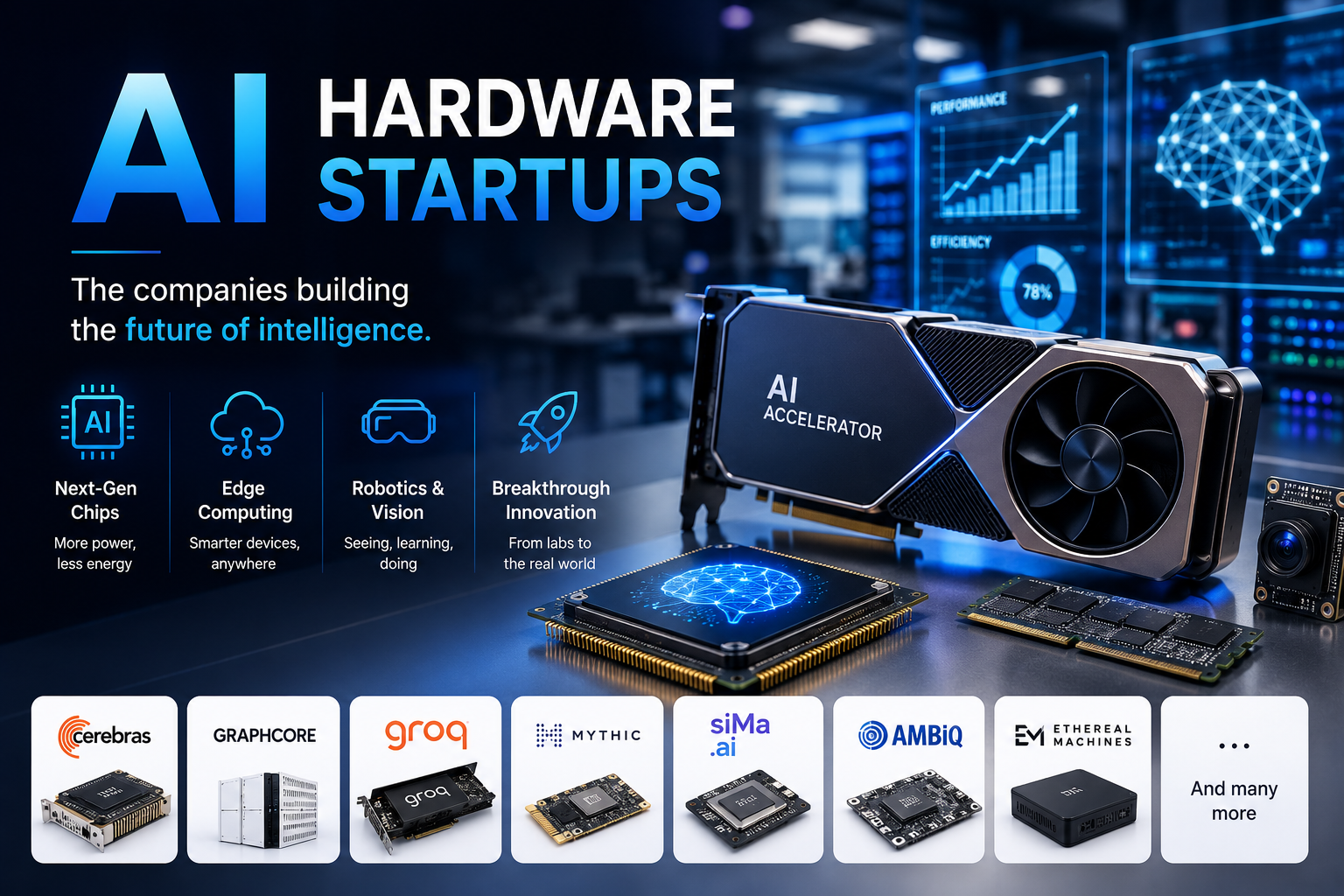
AI Hardware Startups: Companies Building the Future of Compute in 2026
Nvidia is still dominant. But the space around it is more crowded than it’s ever been.
By mid-2026, semiconductor startups have raised over $10.7 billion in the year to date — on track to eclipse 2025 levels by a significant margin. The money is concentrated, not spread evenly. It’s flowing toward companies that can point to something concrete: production hardware, real customers, or a credible technical bet on where AI compute is heading next.
Here’s who’s building what, and why the bets they’re making matter.
Futurelume — covering what’s actually coming
Why AI Hardware Startups Matter Right Now
The compute bottleneck is the bottleneck that everything else runs into.
Model quality improvements, AI agent deployments, robotics, autonomous systems — all of it runs on hardware. And right now, the hardware landscape is shifting in ways that create real openings for challengers.
The shift from training to inference is the key dynamic. Inference workloads — running trained models to produce outputs — are projected to account for roughly two-thirds of all AI compute in 2026, up from a third in 2023. The market for inference-optimized chips is growing to more than $50 billion this year.
Training favors Nvidia’s ecosystem almost absolutely. Inference is a different calculation. The workloads are more diverse. The latency, cost, and energy requirements matter differently. And that creates space for specialized chips that can beat general-purpose GPUs on specific inference workloads.
The Companies Worth Watching
MatX — The LLM-Specific Chip Bet
MatX is building chips optimized specifically for large language models. Not general-purpose AI accelerators — chips designed around the computational patterns that LLMs actually use.
In February 2026, it raised $500 million in Series B led by Jane Street and Situational Awareness. Growing from a $25M seed in March 2024 to $605M in total funding by February 2026, MatX suggests that investors have placed an extraordinary premium on LLM-specific chip architectures.
The thesis: LLMs are the dominant AI workload, they have distinctive computational patterns, and a chip designed specifically around those patterns should outperform a general-purpose GPU on LLM inference. It’s essentially the TPU argument applied to LLMs.
If the bet is right and LLM workloads remain dominant, MatX could be a defining company in AI infrastructure. If architectures shift faster than expected, the specialization becomes a weakness.
Etched — The Transformer-Only Gamble
Etched takes the same logic as MatX and pushes it further. Its Sohu chip is designed specifically for transformer workloads — not just LLMs broadly, but the transformer architecture specifically.
The reported January 2026 financing came to around $500 million at a $5 billion valuation. One of the clearest capital-efficiency outliers in AI chips: reaching a $5B valuation on only $125M of disclosed prior funding.
The bet is aggressive. Transformers are currently central to almost everything important in AI. If they stay central — and nothing on the horizon suggests they won’t be, at least for several years — Etched’s single-minded focus on transformer optimization could produce chips that are dramatically faster and more efficient than general-purpose alternatives.
The risk is architectural. A chip that’s optimized only for transformers is useless if transformers aren’t the dominant architecture. That’s a known risk the company and its investors have accepted explicitly.
d-Matrix — Inference That’s Actually in Production
d-Matrix is the story that moved from interesting to serious in 2026.
In November 2025, it raised $275 million at a $2 billion valuation. Then in June 2026, its Corsair inference platform entered full production — claiming up to 10x faster inference and 5x better energy efficiency than standalone Nvidia GPUs on targeted workloads.
Production changes the conversation. A startup with a big round is interesting. A startup with a big round and hardware entering volume production is much more serious.
d-Matrix’s approach is memory-centric — bringing computation closer to memory to reduce the data movement overhead that constrains inference performance. The June 2026 production signal matters because memory-centric chips are easy to admire on paper and hard to productize.
Ayar Labs — The Interconnect Problem
Most AI hardware discussions focus on the chips themselves. Ayar Labs is focused on what connects them.
As AI systems grow — more chips, larger clusters, more complex multi-chip configurations — the interconnect bottleneck becomes as important as the compute bottleneck. Data moving between chips consumes energy and adds latency. Ayar Labs uses optical interconnects to move data between chips at the speed of light, with significantly lower energy consumption than copper connections.
Its March 2026 $500 million Series E validates that investors see the interconnect layer as strategically critical. The physical AI and robotics advances driving demand for more capable edge systems make efficient chip-to-chip communication increasingly important.
Fractile — The Memory-Bound Inference Bet
As AI models reason longer and more complex tasks become the norm — particularly with the rise of AI agent systems — memory becomes the choke point.
Fractile’s May 2026 $220 million round at a $1.5 billion valuation reflects a specific bet: that inference will become more memory-bound as AI products become more agentic and interactive. Investors aren’t just funding another accelerator — they’re backing a view about where inference bottlenecks will concentrate.
Groq — Fast Inference, Real Revenue
Groq is famous for making fast LLM inference feel like a category before many others did.
Unlike most AI chip startups, Groq is already in production at meaningful scale with real revenue. Its LPU (Language Processing Unit) architecture produces inference speed that’s genuinely impressive on LLM workloads. The public API is accessible and widely used by developers testing the speed advantage.
Groq is the established player in the AI chip startup space — valuable for understanding what the category looks like when it works, and a benchmark for newer entrants.
Lightmatter — Photonic Computing
Lightmatter is building a different kind of chip — one that uses light rather than electrons for computation.
Photonic computing enables multiple computations simultaneously because data arrives as light of different frequencies. This increases operations per unit area and improves energy efficiency in a way that electron-based chips structurally can’t match.
With $822M in total funding, Lightmatter has reached multibillion-dollar scale among photonic AI chip startups. The technology is genuinely different from conventional chip approaches — potentially transformative for energy-intensive inference at data center scale.
The Landscape at a Glance
| Company | Focus | 2026 Funding | Stage |
|---|---|---|---|
| MatX | LLM-specific chips | $500M Series B | Development |
| Etched | Transformer-only chips | ~$500M | Development |
| d-Matrix | Memory-centric inference | $275M Series C | Production (June 2026) |
| Ayar Labs | Optical interconnects | $500M Series E | Commercial |
| Fractile | Memory-bound inference | $220M | Development |
| Groq | LPU inference | $1.8B total | Revenue-generating |
| Lightmatter | Photonic computing | $822M total | Commercial |
| SambaNova | Reconfigurable AI chips | $350M Series E | Revenue-generating |
| Cerebras | Wafer-scale AI systems | IPO 2026 | Public |
| Rebellions | LLM/MoE inference | $400M pre-IPO | Pre-IPO |
What the Funding Patterns Tell You
The signal in 2026 AI hardware funding is concentration, not breadth.
Sub-$50M qualifying rounds have effectively disappeared. Seed funding has fallen from modest to nearly absent. The market is not rejecting new technical ideas — it’s rejecting undercapitalized technical ideas that don’t look capable of reaching manufacturing, packaging, software, and deployment milestones.
What gets funded in 2026: companies that combine architecture with manufacturing plans, customer adoption, strategic investors, or deployable systems. Architecture alone isn’t enough. You need proof that the architecture can become a product.
The inference focus is clear. Training hardware is strategically essential but comparatively underfunded as a startup category — because training at scale is a fight against Nvidia’s strongest ecosystem advantages. Inference is where the openings are.
The Honest Risk Assessment
Most of these companies are making concentrated technical bets that are right or wrong depending on how AI architectures evolve.
The transformer-specific bets (Etched, MatX) are brilliant if transformers remain dominant and risky if architectures shift. The memory-centric bets (d-Matrix, Fractile) are right if inference becomes memory-bound as models get more complex, and less differentiated if the compute bottleneck remains primary. The photonic bets (Lightmatter, Ayar Labs) are early-stage enough that the manufacturing and commercialization risks are still real.
The companies closest to de-risked are the ones actually in production with revenue. Groq, Cerebras, and d-Matrix’s June 2026 production milestone put them in a different category from companies still in development.
AI hardware startups are building the infrastructure layer that everything else in AI will run on. The companies that succeed here will have as much influence over the future of the technology as the model companies above them.
The funding is real. The technical ambitions are serious. And the competition with Nvidia — the most valuable company in the world — is as real as it gets.