Robotics Technology Advances: What’s Actually Changing in 2026
Robotics has been “about to change everything” for about thirty years.
And for most of those thirty years, the gap between what robots could do in a lab and what they could do in the real world was enormous. Controlled environments, predictable tasks, flat surfaces, no surprises. The moment something unexpected happened — a box in the wrong place, a surface that wasn’t level, a human walking through the frame — the whole thing fell apart.
That gap is closing. Not closed. Closing. And the pace of that closure in the last two years has been faster than anything we saw in the previous decade.
Here’s what’s actually moving and what’s still overhyped.
The Manipulation Problem Is Getting Solved
For decades, robotic manipulation — the ability to pick up, move, and interact with objects in the real world — was the hard wall that limited where robots could actually be deployed.
Grasping irregular objects. Handling fragile items. Working with materials that shift and deform. These tasks that a three-year-old does without thinking were genuinely difficult for robotic systems to perform reliably outside tightly controlled conditions.
The combination of better hardware — more dexterous end effectors, improved force sensing — with AI-driven perception and learning has changed this substantially. Robots trained on large datasets of manipulation tasks are now generalizing to objects and scenarios they haven’t seen before. Not perfectly. Not in every environment. But well enough to deploy in real warehouses, real kitchens, real production lines.
This is the advance that unlocks most of the others. Manipulation was the bottleneck. It’s no longer the absolute blocker it was.
Humanoid Robots Are Real — With Caveats
The humanoid robot category has gone from science fiction to venture capital darling to early commercial deployment in about four years.
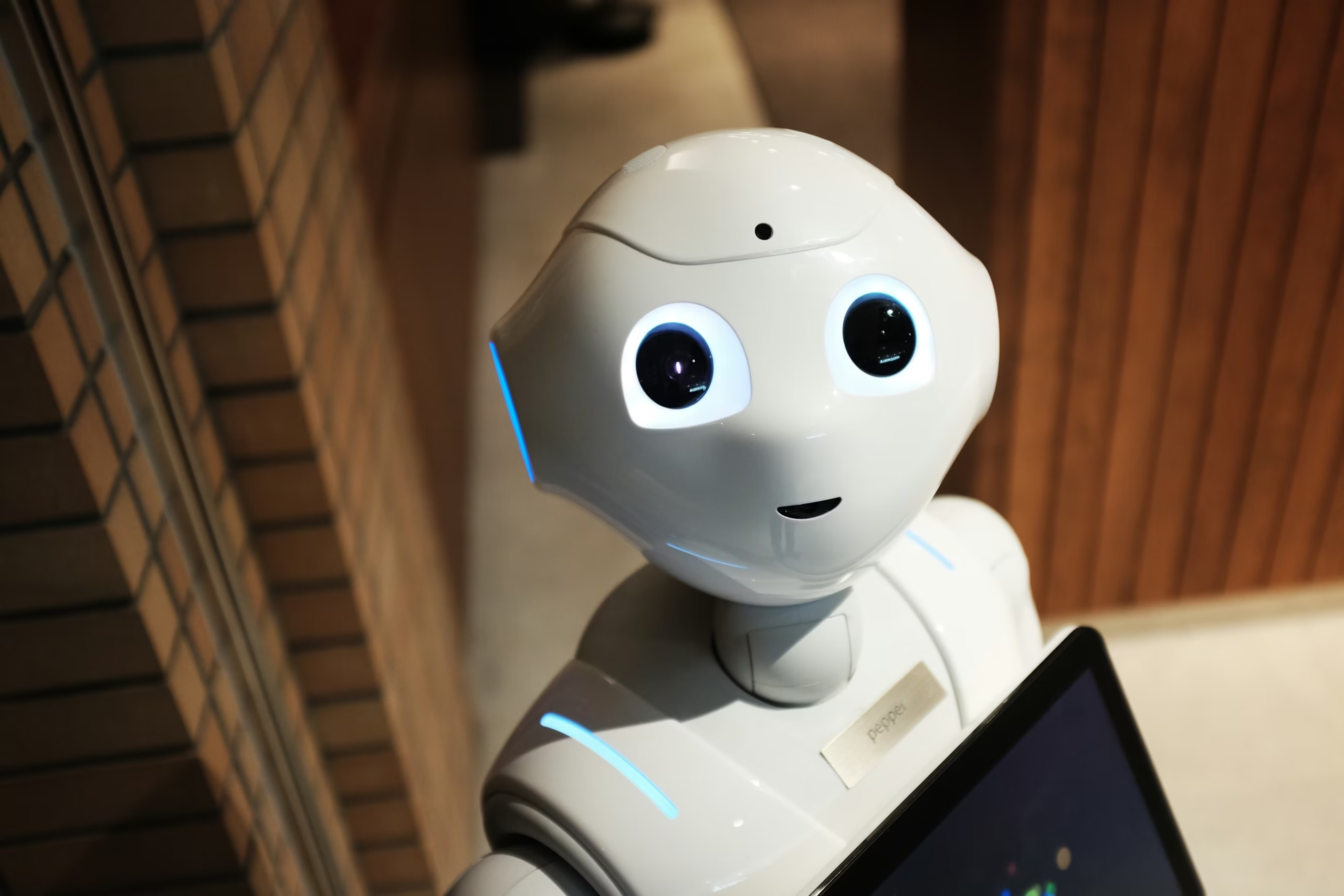
Figure, Agility Robotics, Boston Dynamics, 1X, and a handful of others are all shipping or piloting bipedal robots in real work environments. Warehouses, manufacturing facilities, logistics operations. The form factor makes sense for environments designed around human bodies — the robot can use the same equipment, navigate the same spaces, work alongside human colleagues without requiring infrastructure changes.
The caveats are real though.
Cost is still high. Reliability in genuinely unstructured environments is still limited. The jobs these robots can do today are narrower than the demos suggest. And the maintenance and operational complexity of a humanoid robot in a production environment is not trivial.
The honest picture: humanoid robots are real, they’re working, and the rate of improvement is fast. They’re not replacing broad categories of human labor in 2026. They’re handling specific, defined tasks in controlled-enough environments. The trajectory matters more than the current state.
What’s Actually Deployed vs What’s Still a Demo
This is the distinction that gets blurred constantly in robotics coverage.
| Application | Deployment Status | Reality Check |
| Warehouse picking and sorting | Real, at scale | Specific SKUs, structured environments |
| Autonomous mobile robots (AMRs) | Real, mature | Navigation is solved, manipulation still limited |
| Surgical assistance robots | Real, regulated | High cost, specific procedures |
| Agricultural robots | Early deployment | Selective harvesting, not full automation |
| Humanoid general labor | Pilot stage | Narrow tasks, high supervision |
| Autonomous construction | Early pilot | Specific tasks (bricklaying, rebar), not full sites |
| Home robots | Demo stage | Real environments too unstructured still |
| Last-mile delivery robots | Limited deployment | Geofenced, good weather, flat terrain |
The pattern: robotics technology advances fastest in environments that are structured, predictable, and high-volume. The less structured the environment, the harder the problem, and the further from real deployment we are.
The AI Layer Is What Changed
The hardware improvements in robotics over the last decade were real but incremental. What’s driven the acceleration in the last two to three years is the AI layer — specifically, the application of foundation models and reinforcement learning to robotics problems.
Training robots on large datasets of human demonstrations. Using language models to translate natural language instructions into robot actions. Building systems that can generalize from training environments to novel situations rather than requiring explicit programming for every scenario.
This is the shift that makes the manipulation advances possible. And it’s the shift that’s compressing timelines across the whole field.
The robots being built now aren’t just better hardware running better control software. They’re systems that learn, adapt, and improve with experience in ways that earlier generations couldn’t. That’s a qualitatively different kind of advance.
Where the Real Opportunities Are
Not every industry benefits equally from where robotics technology is right now.
Manufacturing and assembly — already being transformed, more coming. The combination of AMRs for material movement and increasingly capable manipulation for assembly tasks is changing production economics significantly.
Logistics and warehousing — probably the most active deployment environment right now. The economics are clear, the environments are structured enough, and the labor dynamics make the ROI straightforward to calculate.
Healthcare — surgical robotics is mature and growing. The next wave is robotic assistance in care settings — helping with patient handling, medication delivery, routine monitoring. Regulatory pathways are slow but moving.
Agriculture — enormous opportunity, genuinely hard problem. Outdoor environments, variable conditions, enormous variety of crops and tasks. Progress is real but slower than indoor applications.
Construction — one of the last major industries to be significantly affected by automation. The environments are too variable, the tasks too diverse, the regulations too complex. Specific tasks are being automated. Full-site automation is still far.
What’s Still Overhyped
The fully autonomous home robot that does your laundry, cooks dinner, and tidies the house is not 2026. It’s not 2028 either. Unstructured home environments with their infinite variability — different furniture layouts, different objects, different surfaces, children and pets moving unpredictably — remain genuinely hard problems.
The “robots will replace 40% of jobs by 2030” headlines are almost certainly wrong on the timeline, if not the direction. Deployment at scale takes longer than capability development. Infrastructure, regulation, economics, and human factors all slow the adoption curve.
And the general-purpose robot that can do anything a human can do — that’s a research goal, not a product roadmap.
Robotics technology advances in 2026 are real and significant. The manipulation problem is getting solved. Humanoid robots are in real workplaces. The AI layer has changed what’s possible in ways that felt distant just three years ago.
But the distance between a working pilot and scaled deployment is still large. The environments where robots work reliably are still more structured than the real world usually is. And the timeline from “we showed this works” to “this is everywhere” is always longer than the announcement implies.
Watch the trajectory. That’s where the story actually is.