How to Build a Marketing Automation Strategy That Actually Works
Most marketing automation strategies fail before they start.
Not because the technology doesn’t work. Because the strategy wasn’t really a strategy — it was a list of automations someone wanted to build, assembled without a clear answer to why, for whom, and what success looks like.
The result is a marketing stack full of workflows nobody reviews, emails nobody opens, and lead scores nobody trusts. Technically running. Practically useless.
Here’s how to build one that actually works.
Start With the Customer Journey, Not the Tools
The most common mistake: opening the automation platform before mapping the customer journey.
Tools don’t tell you what to automate. Your customer’s behavior does.
Before touching any software, answer these questions for your specific business:
How do people find you? Search, social, referral, paid — and which of those brings the customers who actually stick around?
What happens between first touch and first purchase? What questions do they have? What objections come up? What information do they need at each stage? How long does the process take?
What happens after the first purchase? Do they buy again? What triggers a second purchase? What makes someone a long-term customer versus a one-time buyer?
Write this down. Not in a platform. On paper or in a document. The journey first, the automation second.
This matters because automation is only as good as the process it’s automating. If you don’t understand the journey, you’ll automate the wrong things and wonder why the results don’t move.
Define What You’re Actually Trying to Move
“Improve marketing performance” is not a goal. It’s a category.
Pick one or two specific metrics that matter for your business right now. Not ten. One or two.
Lead-to-customer conversion rate. Time from first contact to first purchase. Email open rate on nurture sequences. Customer lifetime value in year one. Repeat purchase rate at 90 days.
Whatever you pick, make sure you can measure it before you start. If you can’t measure the baseline, you won’t know if anything you build is working.
Then set a realistic target. Not a stretch goal. A target that would represent genuine improvement and is achievable within three to six months of focused effort.
This metric becomes the filter for every automation decision. Does this workflow move this metric? If the answer isn’t clearly yes — build something else first.
The Four Automation Categories Worth Building
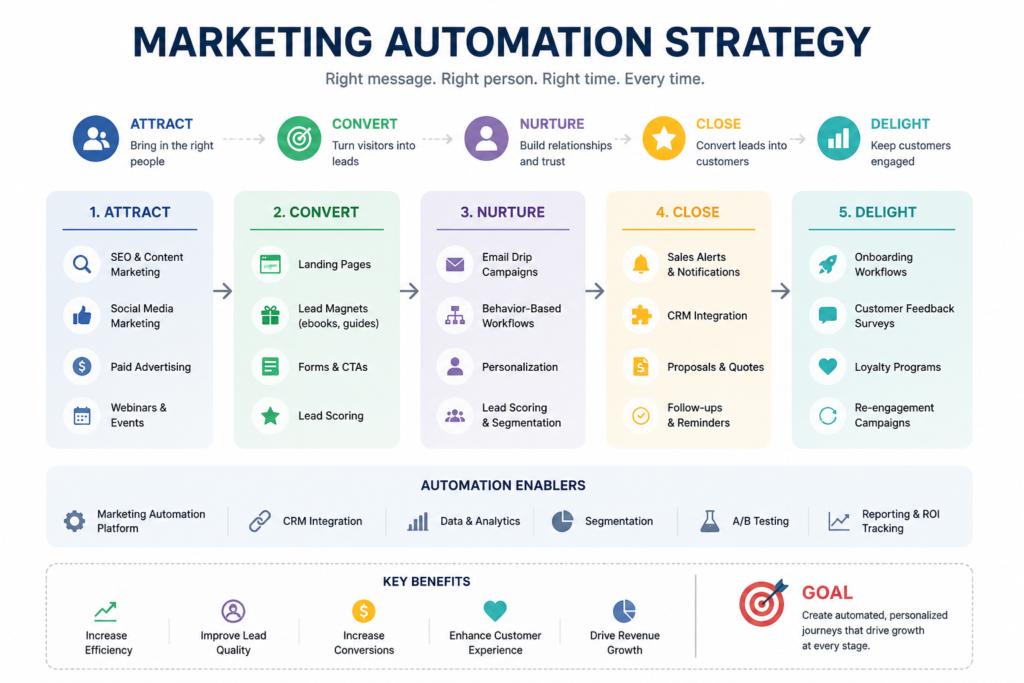
Most marketing automation falls into four buckets. Start with the one that maps to your most important metric.
Lead Nurture Sequences
For businesses with longer sales cycles — B2B, high-consideration purchases, anything where people research before buying — lead nurture is usually the highest-leverage automation to build first.
The basic structure: someone expresses interest (downloads something, attends a webinar, fills out a form). An automated sequence delivers relevant content over days or weeks, moving them from awareness to consideration to readiness to talk.
The key to making this work: the content has to be actually useful at each stage, not just promotional. Nurture sequences that are obviously sales emails disguised as educational content get ignored. Sequences that genuinely help people make a better decision get read.
Onboarding and Activation
For SaaS, subscription products, or any business where the first 30 days determine whether a customer sticks — onboarding automation is often the highest-ROI investment available.
Map what a successful new customer does in the first two weeks. Then build automation that guides new customers toward those behaviors. Triggered emails when they haven’t completed setup. Helpful tips when they first use a feature. Check-ins when engagement drops.
The AI automation layer matters here — AI-powered personalization can adapt onboarding sequences based on what the customer actually does, rather than sending the same sequence to everyone.
Re-engagement
Every list has inactive subscribers. Every customer database has lapsed buyers. Re-engagement automation tries to bring them back before you give up.
The structure is simple: identify contacts who haven’t engaged in 60-90 days, send a short sequence designed to re-activate them, remove the ones who don’t respond.
The removal part matters as much as the re-engagement. Dead weight on your list hurts deliverability and skews your metrics. A smaller, more engaged list outperforms a larger, less engaged one every time.
Post-Purchase and Retention
The cheapest customer to acquire is the one you already have. Post-purchase automation is how you keep them.
Review requests at the right moment. Cross-sell recommendations based on what they bought. Renewal reminders before subscriptions lapse. Loyalty milestones that make long-term customers feel valued.
Most businesses underinvest here relative to top-of-funnel automation. The retention math usually favors more investment in keeping existing customers than in finding new ones.
Choosing the Right Tools
The tool conversation should happen after the strategy conversation. Not before.
That said, a few principles that narrow the field.
Start with what integrates with your CRM. Your automation platform needs to talk to where your customer data lives. If that connection is clunky, everything downstream is compromised. Integrations between HubSpot, Salesforce, and most major automation platforms are mature. Check the specific integration you need before committing.
Don’t over-invest early. The most sophisticated marketing automation platforms are overkill for most businesses until you’ve proven the basic workflows. Start with something you can actually use, not something that has every feature you might need someday.
Measure what the platform makes easy to measure. If pulling the metrics that matter requires an analyst every time, you won’t look at them regularly enough to act on them. The right platform surfaces the numbers you care about without significant friction.
The best workflow automation tools covers the broader automation landscape — the marketing-specific platforms sit alongside these but the integration principles are the same.
The Part Most Guides Skip: Maintenance
Marketing automation isn’t set-and-forget.
Sequences go stale. Offers change. Products get discontinued. Prices update. Customers move through life stages and the messaging that worked six months ago stops resonating.
Build a review cadence into the plan before you build the automations. Quarterly review of open and click rates. Annual audit of every active sequence. Someone whose job includes updating the automations when something changes.
The automation graveyard — full of workflows built by people who’ve since left the company, running on outdated offers, sending emails that embarrass the brand — is a real and common problem. The solution is ownership and maintenance as a planned activity, not an afterthought.
What Good Looks Like at 6 Months
Six months after building a real marketing automation strategy:
Your lead nurture sequence is delivering measurable improvement in lead-to-customer conversion rate. You know this because you measured the baseline before you started.
Your onboarding sequence has reduced churn in the first 30 days. New customers are completing activation steps at a higher rate.
Your re-engagement sequence runs quarterly, keeping your list clean and surfacing lapsed customers worth pursuing.
Someone on your team owns the automations and reviews them regularly.
None of this requires a massive budget or a dedicated marketing operations team. It requires clear thinking upfront, disciplined execution, and consistent measurement.
The fastest growing AI companies are embedding marketing automation into their growth engines from day one — not because it’s trendy, but because the compounding effect on conversion and retention is measurable.
Marketing automation done well compounds over time. The sequence you build this month is still working next year. The customer data you collect today makes the automations you build in six months smarter.
Done poorly, it’s a maintenance burden and a source of embarrassing emails.
The difference is almost entirely in the upfront thinking — mapping the journey, defining the metric, building for the customer’s needs rather than your own convenience.
Do that work first. The technology is the easy part.