

What Is Generative AI? A Plain Answer That Actually Makes Sense
November 2022. ChatGPT launches. Within five days it had a million users.
Most of them had no idea what they were actually using. They just knew it could write things. Good things. Fast. And that felt new in a way that was hard to articulate.
Here’s what was actually new — and why it matters more than most explanations make it sound.
The One Sentence That Explains It
Generative AI creates things. Previous AI classified things.
That’s it. That’s the whole distinction — and it’s bigger than it sounds. We cover what this shift actually means over at Futurelume.
Before generative AI, machine learning was mostly about recognition and prediction. Show it ten thousand cat photos, it learns to identify cats. Feed it sales data, it predicts next quarter’s numbers. Useful. But reactive. It could only work with what already existed.
Generative AI flipped that. Instead of looking at a cat and saying “that’s a cat” — it can create a cat that never existed. Write an essay. Generate a line of code. Produce a voice recording. Compose a song. All from a text description.
That shift — perception to creation — is what made 2022 feel like something changed.
How It Actually Works
I’m going to skip the jargon because it doesn’t help.
The simple version: these models are trained on enormous amounts of data. For text models like ChatGPT, that means a significant chunk of the internet — billions of documents, books, websites. The model learns statistical patterns. Given these words, what comes next? Given this context, what’s a plausible response?
Trained on enough data, that pattern recognition produces outputs that are coherent, contextually appropriate, and often genuinely useful. It’s not magic. It’s very sophisticated pattern completion at massive scale.
The randomness in the process is why it feels creative. The model doesn’t retrieve stored text — it generates new sequences each time, with variation built in. Same prompt, different output every time.
Image models work the same way, just with pixels instead of words. They learn the statistical relationship between text descriptions and visual elements, then generate images that fit those patterns.
What It’s Actually Good For
Some things it handles well. Some things it doesn’t. Most people figure this out by crashing into the limits.
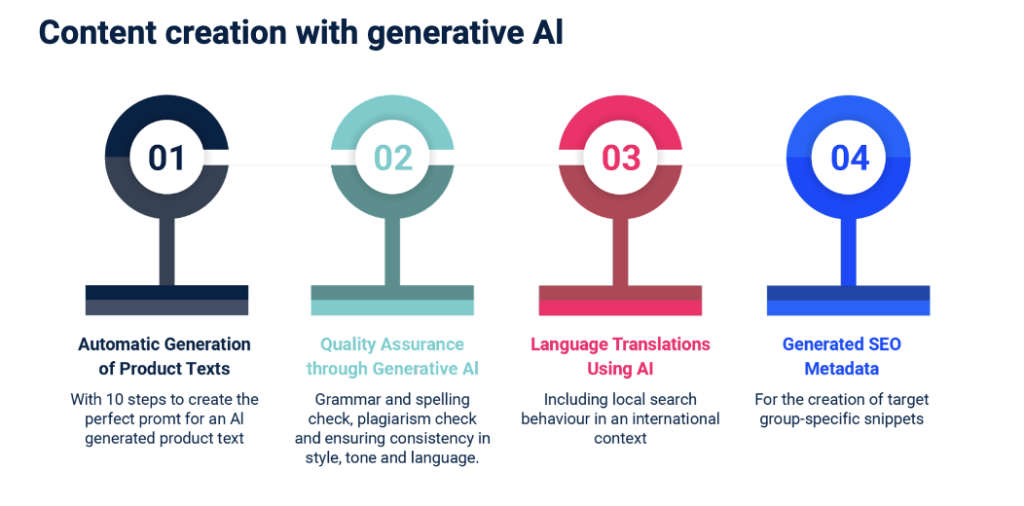
Writing is where most people start. Drafting emails, summarizing documents, generating first drafts of content — these are real time-savers when the human reviews and refines rather than publishing raw output. The starting point appears in seconds. That has genuine value.
Code generation is where the productivity gains are arguably clearest. Developers using AI coding tools consistently get through the repetitive parts of their work faster. Boilerplate, documentation, standard patterns. The hard architectural decisions still need a human. The mechanical parts don’t.
Document processing at scale — reading hundreds of documents and extracting specific information — was genuinely painful before. It’s not anymore.
Image generation for content work — blog headers, social visuals, presentation graphics — is now accessible to anyone who can type a description.
Where It Breaks Down
Here’s the part that gets glossed over in most explainers.
These models don’t know when they’re wrong. They generate the most statistically likely response. That’s not the same as the correct response. The outputs sound confident. They’re not always accurate. This is called hallucination and it’s a real problem that hasn’t been fully solved.
The models also absorb the biases in their training data. The internet is full of biases — racial, gender, cultural. Models trained on internet-scale data inherit those in ways that are subtle and hard to audit.
And the quality of the output depends heavily on the quality of the input. Vague prompts produce vague outputs. Give it a wrong premise and it’ll confidently build on that wrong premise. The skill of using these tools well — knowing how to prompt, when to trust the output, when to verify — takes real time to develop.
A text model producing a medical summary doesn’t understand that the information matters. It produces statistically likely text. Whether that text is accurate is still a human’s job to check.
What’s Moving Fast Right Now
A year ago the big models were getting bigger. That’s shifting. The interesting development now is models getting more capable without getting bigger — faster, cheaper, better outputs from smaller systems. That changes the economics of building with AI significantly.
The other shift worth watching: generative AI moving from a tool you query to systems that take action autonomously. You don’t just ask it to write something — it writes it, sends it, updates the record, and moves to the next task. That’s a different category of capability and a different category of risk.
MIT Technology Review covers the technical side of this well if you want to go deeper.
The Honest Take
Generative AI is genuinely useful. It’s also genuinely limited. Both things are true and neither cancels out the other.
The people getting real value from it are the ones who understand both. They use it for the things it does well — speed, scale, structured tasks — and keep humans in the loop for the things it doesn’t — accuracy, judgment, anything where being wrong has real consequences.
The people who are disappointed by it usually expected it to replace thinking. It doesn’t. It accelerates execution when someone who knows what they’re doing is steering it.
That’s not a knock on the technology. That’s just an accurate description of what it is right now.