
Efficiency-First AI: Why the Era of Bigger Models Is Over
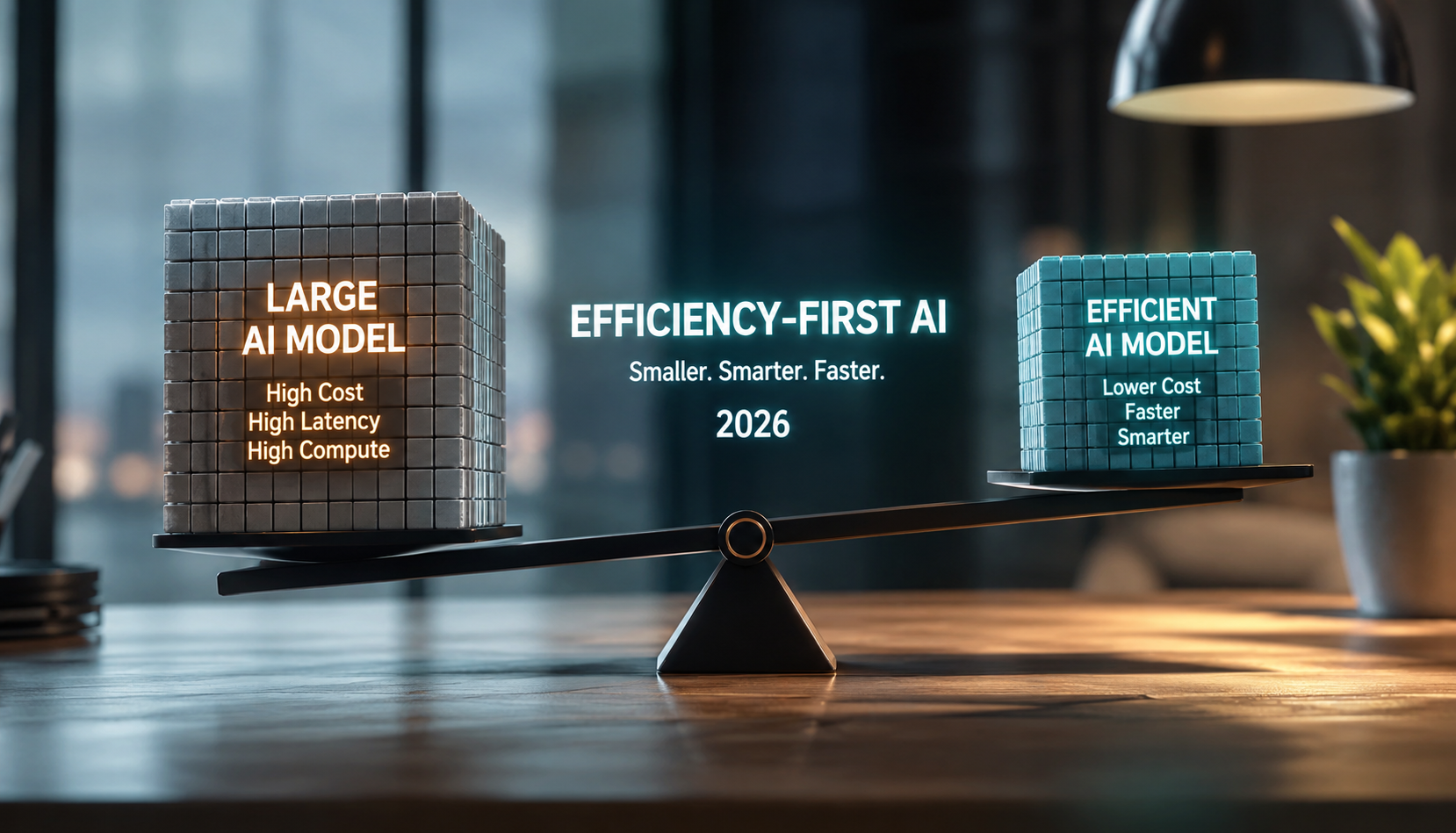
For years, the dominant narrative in AI development was simple: bigger models perform better. In 2026, that narrative has been definitively complicated. A new generation of efficiency-first AI architectures—smaller, faster, cheaper, and frequently superior on domain-specific tasks—is challenging the assumption that parameter count equals capability.
The Technical Drivers of the Efficiency Turn
Advances in model distillation, quantization, mixture-of-experts architectures, and training data curation have demonstrated that much of the performance of large frontier models can be captured in far smaller parameter budgets when the target domain and task distribution are well-specified.
Model Distillation and Quantization
Distillation techniques allow smaller student models to learn from larger teacher models, capturing the majority of performance at a fraction of the parameter count. Quantization further reduces memory and compute requirements by representing model weights at lower precision. Together, these techniques enable deployment of sophisticated AI on hardware that would be inadequate for frontier models.
Mixture-of-Experts Architectures
Mixture-of-experts (MoE) designs activate only a subset of model parameters for any given input, achieving the representational capacity of large dense models with a fraction of the inference compute. This architectural innovation has been central to the efficiency gains of the latest generation of production AI systems.
Economic Pressure and the ROI Imperative
As IDC projects, 70% of organizations are prioritizing ROI and measurable business outcomes when making AI infrastructure decisions—a direct response to the cost shock of deploying frontier models at production scale. Token costs, latency penalties, and infrastructure requirements have created strong incentives to right-size model selection.
The Real Cost of Frontier Model Deployment
Organizations that deployed large frontier models in 2024–2025 frequently discovered that inference costs at production scale were 5–10x higher than initial estimates. Caching strategies, batch processing, and intelligent routing can mitigate these costs, but the fundamental economics favor efficient models for the majority of enterprise workloads.
Hybrid Routing Architectures
The emerging standard is hybrid architecture: lightweight efficient models handle routine inference tasks locally or at low cost, while frontier model calls are reserved for genuinely complex reasoning that requires maximum capability. Organizations implementing intelligent routing report 60–80% inference cost reductions without measurable capability degradation on most production workloads.
Strategic Implications for AI Buyers
The question for AI buyers has fundamentally changed—from ‘which model scores best on benchmarks?’ to ‘which model delivers acceptable performance on our specific task distribution at an acceptable cost and latency?’ This requires internal investment in evaluation infrastructure and task taxonomy.
Building Internal Evaluation Capability
Organizations that rely on public benchmark results to make model selection decisions are making systematically poor choices. Public benchmarks are designed for general capability assessment; enterprise tasks have specific characteristics, failure modes, and quality criteria that require custom evaluation. Building internal evaluation pipelines is a prerequisite for effective model selection.
Domain-Specific Fine-Tuning Strategy
A 7B-parameter model fine-tuned on high-quality domain-specific data routinely outperforms a 70B general-purpose model on in-domain tasks. The investment required—data curation, fine-tuning compute, evaluation—is amortized rapidly when the resulting model is deployed at enterprise scale. Fine-tuning capability is becoming a core enterprise AI competency.
Conclusion
The efficiency-first era in AI rewards organizations that invest in task understanding, evaluation discipline, and architectural sophistication over those that default to the most capable available model. The competitive advantage in enterprise AI is shifting from model access to model operations.