The Future of Tech: What Will Change by 2030?
2030 is four years away.
That’s close enough that the technologies shaping it are already in early deployment. Not vaporware. Not research projects. Things you can use today in limited form that will be ubiquitous by the end of the decade.
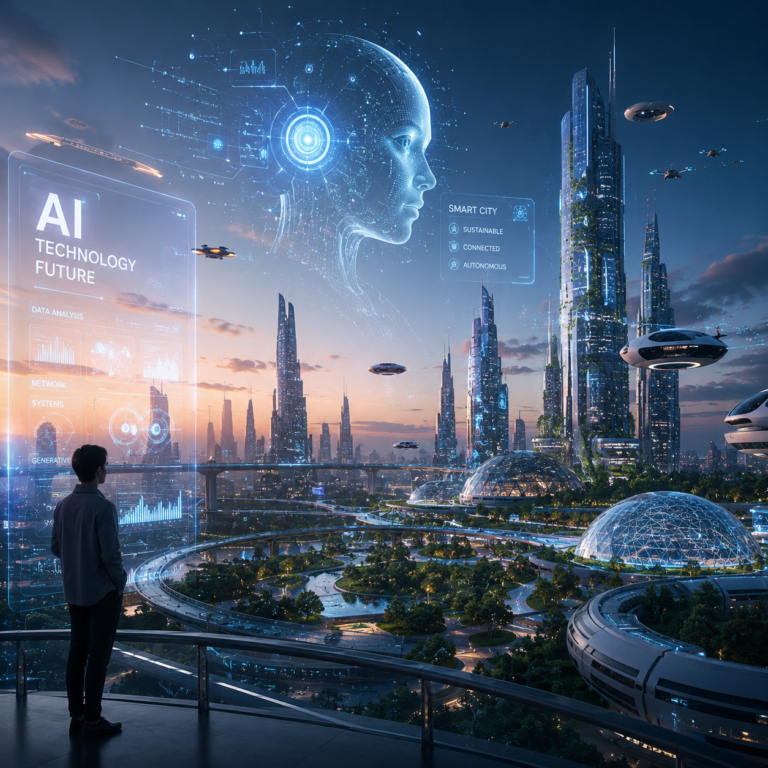
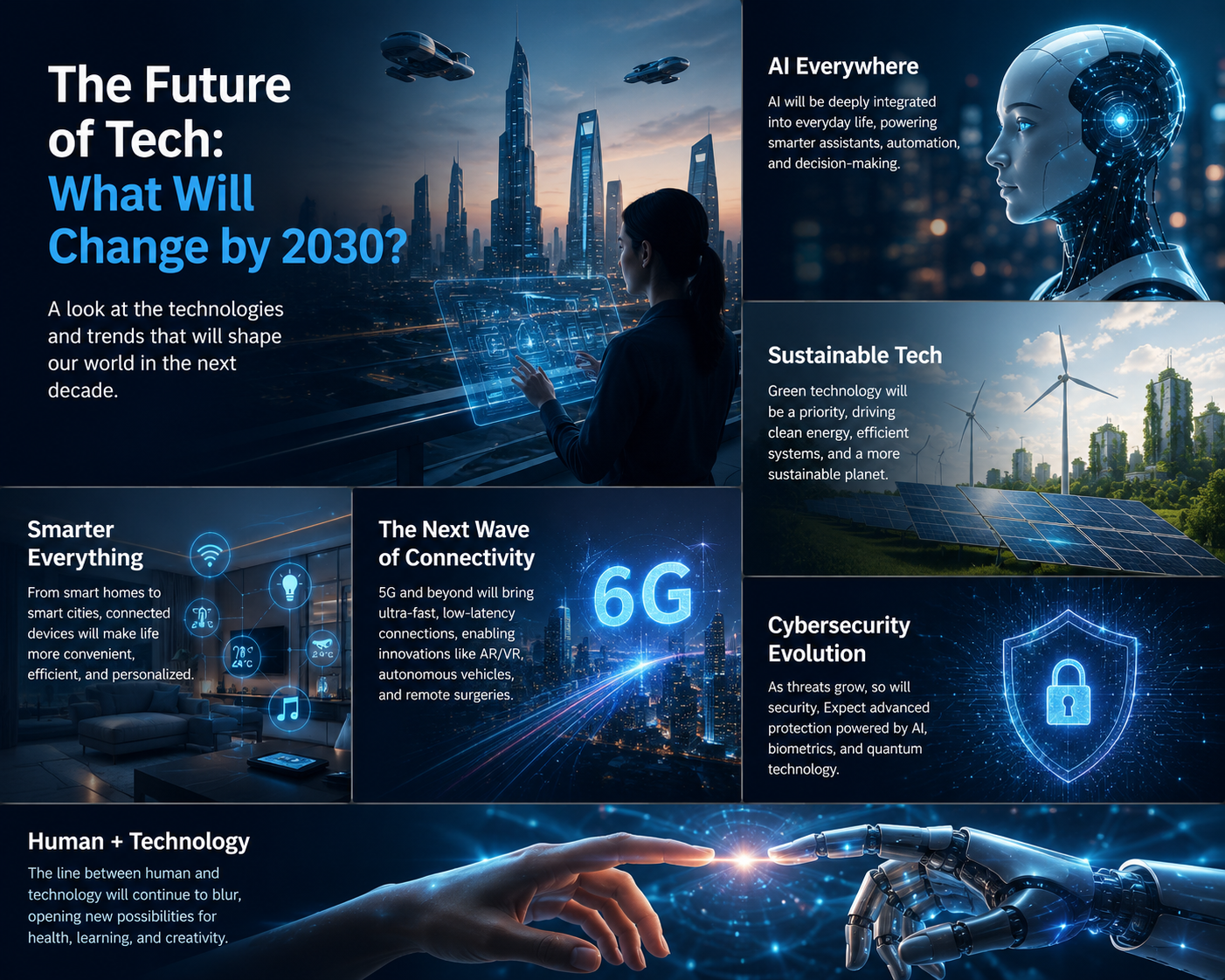
The future of tech by 2030 isn’t about flying cars or brain uploads. It’s about the compounding effects of technologies that are already working — AI agents, physical robotics, quantum computing, next-generation energy infrastructure — reaching the scale where they stop being “emerging” and start being the default.
Here’s what that actually looks like.
AI Moves From Tool to Infrastructure
The shift that’s already underway and will complete by 2030: AI moves from something you use to something that’s embedded in everything you use.
Right now, AI is a tool you reach for — you open Claude, you open ChatGPT, you use Copilot in your IDE. By 2030, AI will be embedded in the operating layer of most software. Not as a separate chat interface. As the capability that makes software smarter, faster, and more personalized by default.
The more significant shift is from AI as assistant to AI as agent. By 2030, autonomous AI systems handling multi-step workflows without human involvement at each step will be standard in knowledge work environments. Research, drafting, analysis, scheduling, communication — much of the operational layer of office work will be handled by AI systems, with humans setting direction and reviewing outputs.
This isn’t replacing all work. It’s changing what work looks like — less time on execution, more time on direction, judgment, and relationship.
Physical AI: Robots in Real Environments
The thing that’s been “five years away” for thirty years is actually arriving.
The manipulation problem — getting robots to handle objects reliably in unstructured real-world environments — is getting solved. Not fully solved. But meaningfully closer than it was two years ago.
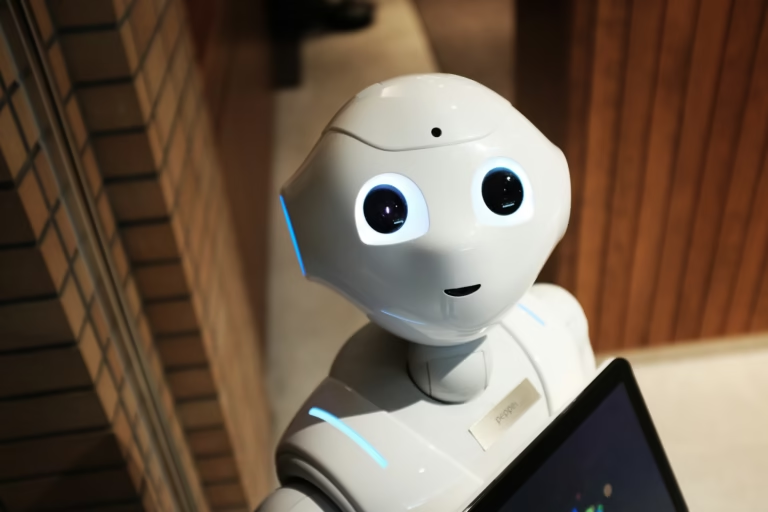
Robotics technology advances in 2026 have put humanoid robots in real warehouse and manufacturing environments. By 2030, this will have expanded significantly — more environments, more tasks, lower unit costs, better reliability.
The industries that will feel this most by 2030:
| Industry | What Changes by 2030 | What Stays Human |
|---|---|---|
| Logistics / Warehousing | Picking, sorting, last-mile prep largely automated | Customer relationships, exception handling |
| Manufacturing | Routine assembly increasingly robotic | Quality judgment, process design |
| Healthcare | Medication delivery, patient monitoring assistance | Care, diagnosis, emotional support |
| Agriculture | Selective harvesting, monitoring, planting | Strategy, exception management |
| Construction | Specific tasks (rebar, bricklaying) automated | Design, complex coordination |
The conversation about AI and jobs focuses almost entirely on knowledge work. The impact on physical labor is likely larger and faster. That conversation is barely happening.
Quantum Computing Crosses into Practical Use
Quantum computing crossed a commercial threshold in 2026. By 2030, it will be a standard tool in specific high-value domains.
Drug discovery will be the most visible application. Quantum chemistry simulation allows molecular modeling at a level of accuracy that classical computers can’t match. Pharmaceutical companies that build quantum capability now will have a meaningful advantage in identifying drug candidates.
Financial services will be another high-impact area. Portfolio optimization, derivative pricing, risk modeling — the combinatorial problems in finance are a natural fit for quantum approaches.
The more urgent near-term implication: cryptography. The harvest-now-decrypt-later threat — collecting encrypted data now to decrypt once quantum computers are capable — means organizations with long data retention and sensitive information need to begin post-quantum cryptographic migration now. Waiting until 2030 is waiting too long.
The Energy Transition Completes in Major Markets
The energy transition is further along than most people outside the energy sector realize.
Solar and wind are already the cheapest sources of new electricity generation in most markets. The remaining barriers are storage and grid management, and both are being actively addressed.
Solid-state batteries are approaching commercial production — higher energy density, faster charging, longer cycle life than current lithium-ion. Grid-scale storage is being deployed at meaningful scale. Green hydrogen is finding its role in long-duration storage and industrial decarbonization.
By 2030, clean energy will be the default economic choice in most markets — not because of policy mandates, but because the numbers work. This has significant implications for energy geopolitics, industrial competitiveness, and climate trajectory.
What this means for the tech industry specifically: data center energy costs, which are a significant concern given AI’s power requirements, will increasingly be addressable through on-site renewable generation and storage.
Spatial Computing Finds Its Professional Use Cases
Consumer AR has been “about to arrive” for a decade. By 2030, it probably still won’t be the mainstream computing interface — the phone and laptop aren’t going anywhere.
What will be mainstream by 2030 is spatial computing in specific professional contexts:
- Surgical planning and guidance
- Remote technical assistance (an expert sees what a field technician sees)
- Architectural and engineering design review
- Training and simulation for complex physical tasks
- Collaborative design in distributed teams
The form factor will keep improving. The Apple Vision Pro established a baseline. By 2030, devices will be lighter, cheaper, and more capable. They won’t be worn all day by most people. They’ll be reached for when the use case calls for them.
What the Future of the Tech Industry Looks Like
The structure of the technology industry itself will look different by 2030.
| Trend | Direction by 2030 |
|---|---|
| AI foundation models | Commoditizing — capabilities widely available, competition on applications |
| Vertical AI | Growing fast — domain-specific AI with proprietary data has durable moats |
| Hardware | Proliferating — AI chips, edge compute, specialized silicon |
| Cloud concentration | Continuing — AWS, Azure, GCP further entrenched |
| Open source AI | Stronger — Llama-class models competitive with closed alternatives |
| Regulation | Increasing — EU AI Act enforced, US frameworks emerging |
| Talent | Shifting — AI tools raise productivity, reduce headcount in some roles |
The software businesses that will matter most in 2030 are the ones being built now that combine AI capability with proprietary data and workflow integration that makes them genuinely hard to replace. The ones that are thin wrappers around foundation models without these elements are already under margin pressure.
What Doesn’t Change
Worth saying, because the future of tech discussions often make it sound like everything is about to be different.
Trust is still built through human relationships. Complex decisions still require human judgment with full context. Creative work that’s genuinely original still comes from human experience and perspective. The fundamentals of what makes a business valuable — serving customers well, building sustainable unit economics, creating something that solves a real problem — don’t change because the tools do.
The technology changes what’s possible. It doesn’t change what matters.
The Practical Implication for Right Now
The technologies that will define 2030 are available today in early form.
The people and organizations positioning themselves well for 2030 are the ones using these tools now — building fluency with AI, understanding where automation creates leverage, identifying the judgment and relationship work that becomes more valuable as execution gets cheaper.
The future of work isn’t a cliff — it’s a gradient. The people who adapt incrementally, consistently, and intentionally will find themselves in a much better position than the ones who wait until the change is impossible to ignore.
The future of tech by 2030 is not science fiction. It’s the near-term compounding of technologies that are already working — getting cheaper, more reliable, and more widely deployed with each passing year.
The direction is clear. The pace is faster than most organizations are treating it. And the window to position yourself ahead of the change, rather than in response to it, is narrowing.