
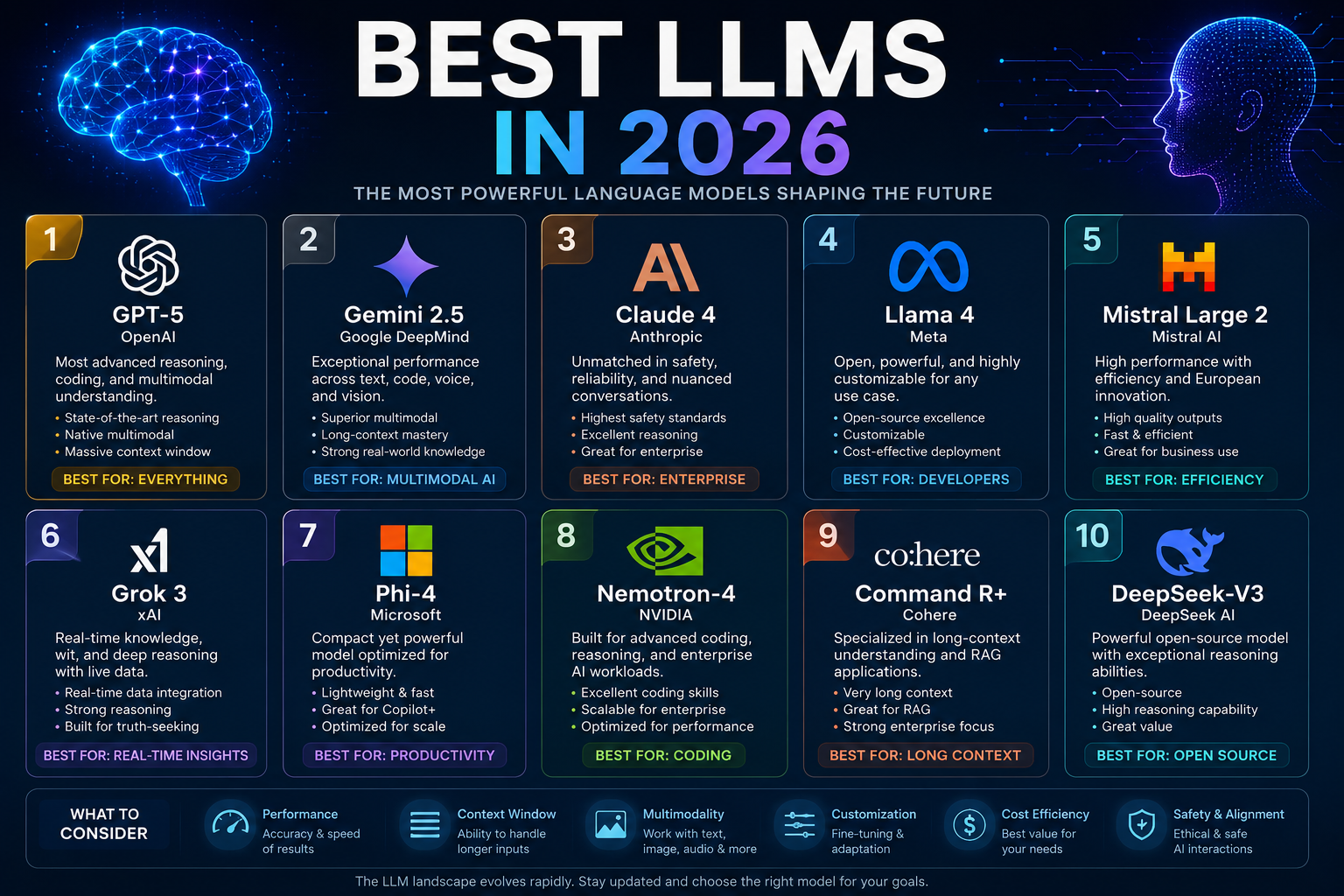
The LLM landscape in 2026 is genuinely confusing.
A year ago there were three or four serious options. Now there are dozens. Every major tech company has a flagship model. Every open-source project has a new release every few weeks. The benchmarks contradict each other. The marketing is identical.
I’ve used most of the major ones for real work. Here’s the honest version of which ones are actually worth using — and for what.
Before the List: What “Best” Actually Means
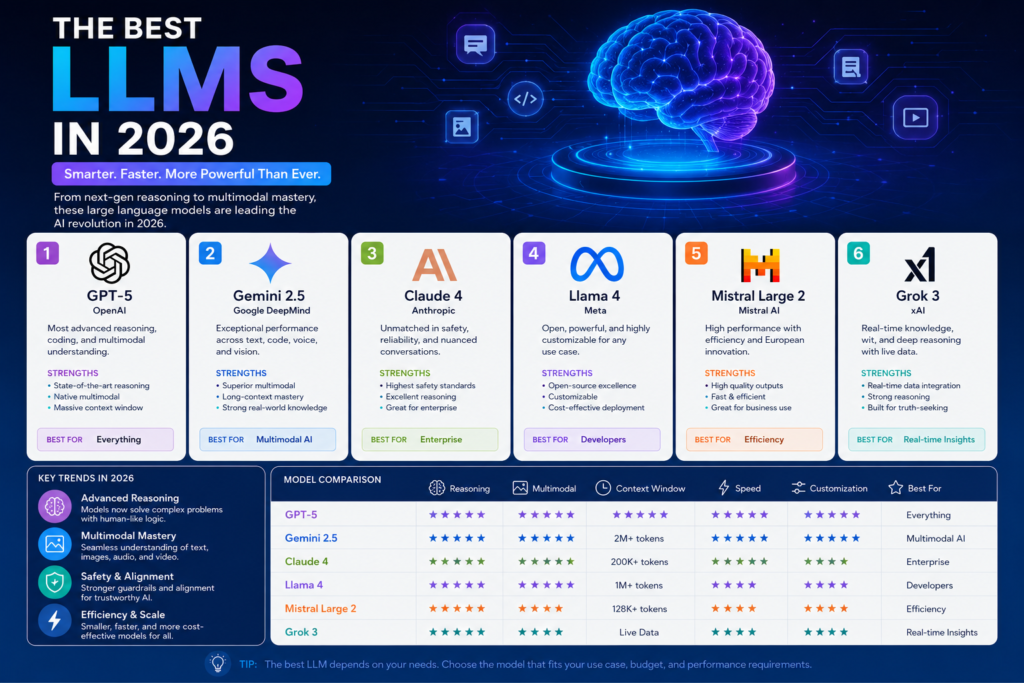
There’s no universally best LLM. There’s best for your use case. Here’s a look at the best LLMs you can use in 2026 before we get into the breakdown.
The dimensions that matter: reasoning quality for complex tasks, instruction following for structured work, speed for high-frequency use, cost for volume applications, context window for long documents, and whether you need the model to be open source or self-hostable.
Different models win on different dimensions. The right answer depends on what you’re actually doing.
GPT-4o (OpenAI)
Still the most versatile general-purpose model available.
The tool use is reliable. The multimodal capabilities — processing images, documents, and text together — are strong. The ecosystem around it is the most mature: more integrations, more documentation, more examples of production deployments than any other model.
For teams that need one model that handles everything reasonably well, GPT-4o is still the default. Not the best at any single thing, but the most consistently capable across a wide range of tasks.
The o-series reasoning models — o3 and o4-mini — are worth knowing about separately. For tasks that require deep multi-step reasoning — complex analysis, hard math, code debugging — the o-series is meaningfully better than standard GPT-4o. The tradeoff is speed and cost.
Best for: General purpose, tool use, multimodal tasks, teams that need broad capability.
Watch out for: Cost at scale. The o-series models are expensive for high-volume applications.
Claude 3.5 Sonnet / Claude 4 (Anthropic)
The model I reach for most often for writing and analysis.
Instruction following is the strongest of any model I’ve used regularly. When you give Claude a complex, nuanced prompt — with specific constraints, specific tone requirements, specific things to avoid — it follows them more reliably than GPT-4o. For content work, that matters a lot.
The reasoning quality on complex analytical tasks is excellent. The context window handles long documents well. And Claude is noticeably more careful about edge cases — it’ll flag when something doesn’t quite make sense rather than confidently generating a wrong answer.
The generative AI tools landscape covers Claude in more detail — but the short version is that for writing-heavy workflows, Claude is the model most professionals I know have settled on.
Best for: Writing, analysis, complex instruction following, long-document work.
Watch out for: The ecosystem is less mature than OpenAI’s. Fewer third-party integrations.
Gemini 1.5 Pro / Gemini 2.0 (Google)
The model to know if you work with mixed media inputs.
The multimodal capability is genuinely differentiated. If you need to reason across text, images, audio, and video simultaneously — Gemini handles this better than the alternatives. The context window is enormous, which matters for tasks that require processing large amounts of information in a single pass.
The integration with Google Workspace — Docs, Sheets, Gmail — is the tightest of any model with that ecosystem. For teams running on Google tools, Gemini is embedded in a way that reduces friction significantly.
The developer experience has improved considerably from a year ago. It’s not quite at OpenAI’s level but it’s close enough that it’s not a reason to avoid it anymore.
Best for: Multimodal tasks, Google Workspace users, large context window requirements.
Watch out for: Inconsistent performance on purely text-based reasoning compared to Claude and GPT-4o.
Llama 3.3 / Llama 4 (Meta)
The open-source option that’s actually worth using.
Meta’s Llama models have closed the gap with closed-source models significantly. For many tasks Llama 3.3 70B is competitive with GPT-4o at a fraction of the cost — especially when self-hosted or run through inference providers like Groq or Together AI.
The use cases where open-source makes the most sense: privacy-sensitive applications where data can’t leave your infrastructure, high-volume applications where API costs at scale are prohibitive, and customization requirements where fine-tuning on proprietary data matters.
The tradeoff is setup complexity. You’re managing infrastructure rather than calling an API. For teams with the technical capacity, that’s fine. For teams without it, the managed API options are easier.
Best for: Privacy-sensitive workloads, high-volume cost optimization, fine-tuning for specific domains.
Watch out for: Infrastructure overhead. Not plug-and-play.
Mistral Large
The European option that matters for compliance reasons.
The model quality is genuinely good — competitive with GPT-4o on most benchmarks, stronger than most alternatives at European language tasks. But the reason most organizations choose Mistral isn’t the benchmarks. It’s the data sovereignty.
For organizations that can’t route data through US-based infrastructure — European enterprises, regulated industries with specific data residency requirements — Mistral is often the answer. The fact that it’s also a capable model makes the compliance choice easier to justify.
Best for: European organizations, data sovereignty requirements, GDPR-sensitive applications.
Watch out for: The frontier capability gap with OpenAI and Anthropic is real, though narrowing.
Grok 3 (xAI)
Worth knowing about, not the default choice.
Grok 3 is competitive on reasoning benchmarks and has some genuinely strong capabilities for coding and technical tasks. The integration with X (Twitter) data gives it real-time information access that other models don’t have natively.
The reason it’s not higher on this list: the ecosystem is less mature, the API reliability has had growing pains, and for most use cases the other models are easier to build on.
For technical tasks and coding specifically — Grok 3 is worth trying. It’s better than its reputation suggests.
Best for: Coding, technical reasoning, real-time information needs.
Watch out for: Ecosystem maturity, API reliability.
How to Actually Choose
| Use Case | Model to Start With |
|---|---|
| General purpose, broad capability | GPT-4o |
| Writing and complex instruction following | Claude |
| Multimodal, mixed media inputs | Gemini |
| Deep reasoning, hard problems | GPT-o3 or o4-mini |
| Privacy-sensitive, self-hosted | Llama 3.3/4 |
| European data sovereignty | Mistral Large |
| Coding and technical tasks | Claude or Grok 3 |
| Google Workspace integration | Gemini |
The Honest State of the Market
The gap between the top models has narrowed significantly in the last year. A task that clearly required GPT-4o twelve months ago can often be handled well by Claude, Gemini, or even a capable open-source model today.
That’s good news for users. It means you’re less locked in to any single provider. It also means the choice matters less than it used to — the differences between top-tier models on most tasks are smaller than the differences in how well you’re prompting them.
The AI agent tools comparison covers the infrastructure layer around LLMs — which matters as much as the model itself for anything beyond simple queries.
The model is one input. How you use it is the other. Both matter.
The best LLM in 2026 is the one that fits your use case, your technical constraints, and your budget — not the one with the highest benchmark score or the most recent launch announcement.
Test the ones that seem relevant to your actual work. Run your real tasks, not synthetic benchmarks. Pick based on what you see, not what you read.
That’s still the only evaluation method that works.