ChatGPT vs Claude: Which One Should You Actually Use in 2026
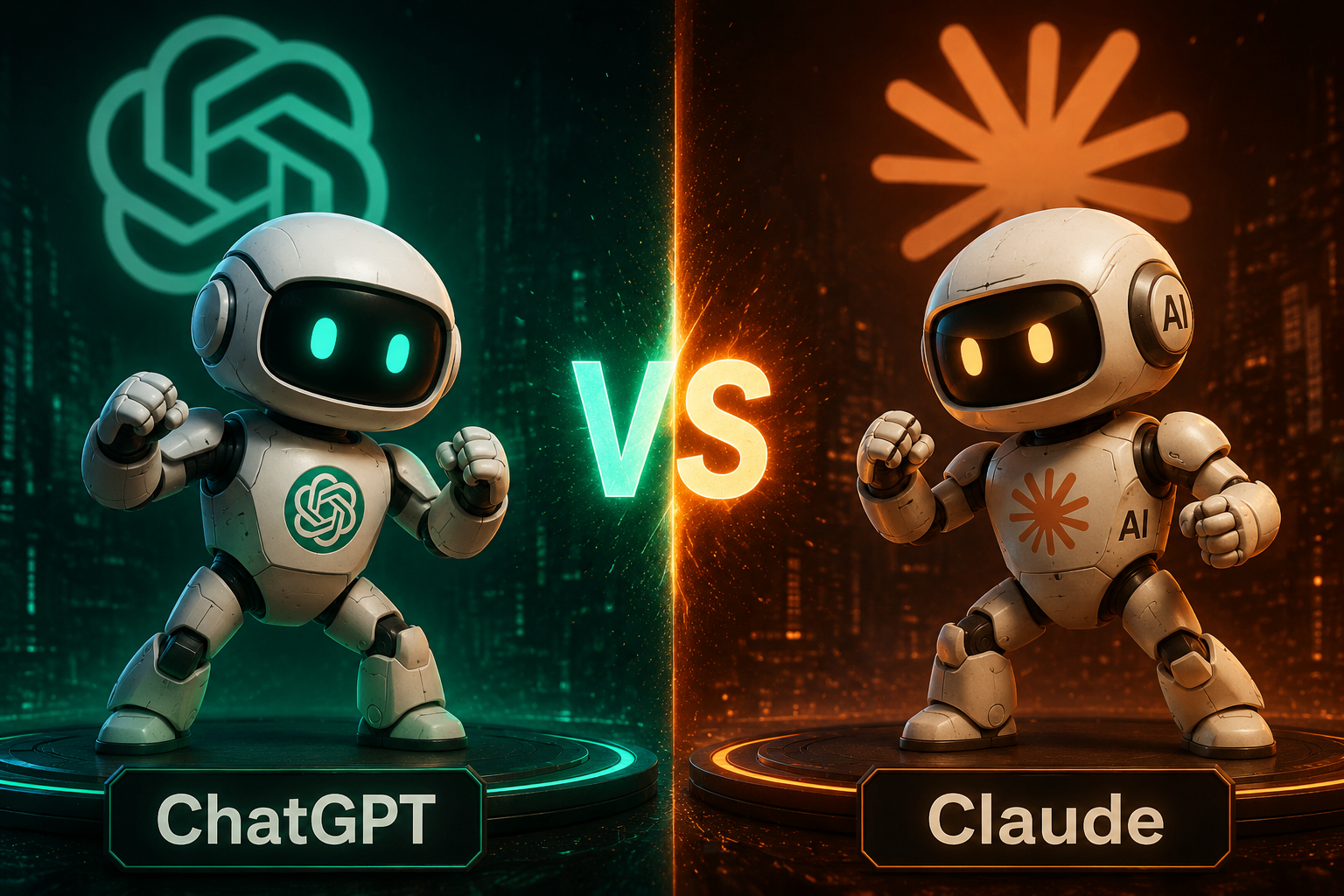
I’ve been using both for over a year. Not casually — for real work, daily.
The honest answer to “which one is better” is that it depends on what you’re doing. But that’s a cop-out if I don’t tell you specifically what each one does better and why it matters.
So here’s the actual breakdown.
Futurelume — where AI gets real
The Quick Version
If you write a lot — ChatGPT vs Claude isn’t even close. Claude wins.
If you need broad capability, tool integrations, and the widest ecosystem — ChatGPT wins.
If you’re doing deep reasoning tasks — GPT o-series is better than both standard models.
Everything else is nuance. Let’s get into it.
Writing Quality
This is where the gap is most visible.
Claude follows complex instructions more reliably. If you give it a prompt with specific tone requirements, specific things to avoid, specific structural constraints — it actually follows them. ChatGPT has a tendency to do what it thinks you want rather than what you said. That sounds like a small difference. Over dozens of writing tasks it becomes a significant one.
Claude’s output also tends to feel less generic. ChatGPT has a house style that shows up even when you’re trying to avoid it — a certain smoothness, a certain structure. Claude is easier to steer toward something that sounds like a specific person wrote it.
For anyone doing content work seriously — articles, reports, emails, anything where voice and instruction-following matter — Claude is the better tool.
Winner: Claude
Reasoning and Problem Solving
This one is more nuanced.
For standard reasoning tasks — working through a problem, analyzing a situation, making a decision — Claude and GPT-4o are genuinely close. Both are strong. The differences are at the margins.
Where ChatGPT pulls ahead: the o-series models. GPT-o3 and o4-mini are specifically built for deep, multi-step reasoning. Hard math, complex code debugging, scientific analysis — the o-series handles these better than anything Claude currently offers at the same price point.
If your work regularly involves genuinely hard reasoning problems, the o-series is worth knowing about. For most people’s actual daily tasks, the difference between Claude and GPT-4o is not significant.
Winner: ChatGPT (o-series for hard problems), roughly equal for everyday tasks
Coding
Both are useful for coding. Neither is the best coding tool — that’s Cursor or GitHub Copilot for most developers.
For quick code questions, debugging help, or generating small functions — they’re roughly equivalent. Claude tends to produce cleaner code with better explanations. ChatGPT has more examples in its training data for common patterns and frameworks.
For serious coding work, integrate whichever model you prefer into Cursor or Copilot rather than using the chat interface directly. The AI agent tools comparison covers this — the chat interface is not where coding assistance shines.
Winner: Roughly equal, but neither is the right tool for serious coding work
Research and Current Information
ChatGPT has web search built into the standard interface. Claude’s web search is available but less seamlessly integrated in the chat interface.
For research that requires current information — recent events, current prices, recent releases — ChatGPT’s web search integration is more convenient out of the box.
That said, if research is your primary use case, neither ChatGPT nor Claude is the right answer. Perplexity is built specifically for research with sources and handles it better than either.
Winner: ChatGPT for convenience, Perplexity for actual research work
Handling Sensitive or Complex Topics
Claude is noticeably more careful here — sometimes frustratingly so, sometimes genuinely usefully so.
On topics that require nuance — ethical questions, sensitive subjects, legally adjacent content — Claude tends to engage thoughtfully rather than either refusing outright or bulldozing through. ChatGPT is more likely to either comply without friction or refuse with a generic explanation.
Whether Claude’s caution is a feature or a bug depends entirely on what you’re doing. For professional work that involves sensitive topics, the thoughtful engagement is usually better than the alternatives. For tasks where you just need something done, it can slow you down.
Winner: Claude for nuanced topics, ChatGPT for fewer friction points
Ecosystem and Integrations
This is where ChatGPT wins clearly and it matters more than people give it credit for.
The plugin ecosystem, the API maturity, the number of third-party tools built on ChatGPT — it’s significantly larger than Claude’s. If you’re building workflows, automations, or products on top of an LLM, the ChatGPT/OpenAI ecosystem has more options, more documentation, and more examples.
For individual users just using the chat interface, this matters less. For teams building on top of AI, it matters a lot.
Winner: ChatGPT
Pricing
Both have free tiers. Both have paid tiers around $20/month for standard access.
The meaningful pricing difference is at the API level for developers and teams. OpenAI’s API pricing and Claude’s API pricing are competitive but differ by model and use case. For high-volume applications, running the numbers on your specific usage pattern matters.
For individual users on the standard paid tier — the pricing is close enough that it shouldn’t be the deciding factor.
Winner: Roughly equal at consumer pricing
The Honest Summary
| Task | Better Choice |
|---|---|
| Writing and content | Claude |
| Complex instruction following | Claude |
| Hard reasoning problems | ChatGPT (o-series) |
| Everyday reasoning | Roughly equal |
| Coding assistance | Roughly equal (use Cursor for serious work) |
| Research with sources | Perplexity |
| Web search integration | ChatGPT |
| Ecosystem and integrations | ChatGPT |
| Nuanced / sensitive topics | Claude |
| API and building on top | ChatGPT |
Which One Should You Pay For
If you’re going to pay for one and you do a lot of writing — Claude.
If you need broad capability, use multiple tools regularly, or are building something on top of AI — ChatGPT.
If you’re not sure — both have free tiers that are genuinely useful for evaluation. Use them both for a week on your actual tasks. The answer will become obvious.
The best LLMs in 2026 covers the broader landscape if you want to see where both sit relative to Gemini, Llama, Mistral, and the other major models.
ChatGPT and Claude are both genuinely good. In 2024 ChatGPT was clearly ahead on almost everything. In 2026 Claude has closed the gap and pulled ahead in specific areas.
The competition is making both better faster than either would improve alone. That’s good for everyone using them.
Pick based on your actual work. Test on real tasks. Don’t pick based on brand or hype.